
The Distribution Manifesto
Chapter 11 of 11 · 20 min read
The 90-Day Distribution Build
Turn the Book Into an Operating System
The argument
The central claim of this book is that distribution has become an infrastructure problem.
It is no longer enough to have a content calendar, an ad account, a social media manager, a creator deal, an affiliate program, or a clipping campaign. Each of those can still create value. None of them, by itself, is a complete distribution system.
The durable advantage is the operating layer that coordinates them.
That layer turns content into many usable assets. It turns creators into networked distribution nodes. It turns incentives into predictable behavior. It turns performance data into learning. It turns learning into capital allocation. It turns campaigns into reusable infrastructure.
That is the shift from media activity to distribution infrastructure.
This book has introduced the vocabulary for that shift. The point of the vocabulary is not to sound proprietary. The point is to make a new operating reality easier to see, diagnose, teach, measure, and improve.
A market cannot mature until it has language.
A company cannot manage what it cannot name.
A team cannot scale what it cannot define.
Creator-Powered Distribution is the name for the category. The Distribution Infrastructure Layer is the operating system. Clipping campaigns are one of the strongest entry mechanisms. Creator networks are the channel. Content liquidity is the raw material. Distribution efficiency is the economic test. Build-vs-buy is the operating-model decision.
The remaining work is implementation.
The Distribution Ontology
An ontology is a structured map of a domain. It defines the objects in the system, the relationships between them, and the categories used to reason about them.
The distribution ontology introduced in this book has seven layers.
| Layer | Core Question | Primary Concepts |
|---|---|---|
| Market Condition | Why does this matter now? | Attention Crisis, Attention Arbitrage, Audience Saturation Curve, Platform Dependency Risk |
| Category | What is the new model? | Creator-Powered Distribution, Networked Distribution, Distribution Infrastructure Layer |
| Inputs | What raw material powers the system? | Source Content Inventory, Atomic Content Units, Content Liquidity, Media Liquidity, Content Surface Area |
| Network | Who carries the message into market? | Creator Network, Creator Network Node, Creator Density, Creator Fit, Creator Capital |
| Mechanisms | How does the system activate? | Clipping Campaigns, Repurposing Paths, Creator Briefs, Clip Units, Qualified Views |
| Economics | How is performance judged? | Creator-Powered CPM, Distribution Efficiency, CPQV, CPQO, Reusable Asset Rate, Learning Yield |
| Operating Model | How is the system owned and governed? | Build-vs-Buy, TCDO, Vendor Evaluation, Hybrid Operating Model, Strategic Control Layer |
The old ontology of distribution was channel-based.
Paid media. Organic social. Influencer. Affiliate. PR. Community. SEO. Email. Partnerships.
Those labels are still useful, but they are not sufficient. They describe where activity appears, not how distribution capacity is built.
The new ontology is infrastructure-based.
It asks:
- What is the source content inventory?
- How liquid is the content?
- Which audience pockets matter?
- Which creator nodes can reach those pockets?
- Which mechanisms activate those nodes?
- Which assets create qualified attention?
- Which incentives produce the right behavior?
- Which metrics separate signal from noise?
- Which operating model produces speed, control, and accountability?
- Which loops compound over time?
This is a different management system.
A channel-based organization asks, “What should we post this week?”
An infrastructure-based organization asks, “What distribution capacity are we building this quarter?”
That shift is the practical meaning of the new attention economy.
What Has Changed
The first chapter framed the starting problem: attention is not scarce in aggregate, but reliable access to qualified attention is harder to engineer.
The internet did not run out of attention. It produced too much surface area, too many feeds, too many creators, too many formats, too many paid placements, too many messages, and too many competing claims on audience trust.
The result is a coordination problem.
Brands still need distribution, but distribution now requires more than buying impressions or publishing from owned accounts. It requires a system capable of routing content through many nodes, formats, incentives, and feedback loops.
Four changes matter most.
2.1 Attention Fragmented
Audiences did not simply move from one old channel to one new channel. They fragmented across many platforms, communities, creators, formats, and micro-contexts.
A company cannot assume one primary publishing surface will carry the market. It must design for surface-area expansion.
2.2 Trust Moved Closer to People
Institutional trust still matters, but many buying, learning, and belief-formation moments now happen through individuals: creators, operators, analysts, editors, customers, employees, community members, and niche authorities.
That does not mean every creator is trusted. It means trust is increasingly contextual.
The operator’s job is not to rent fame. The operator’s job is to match message, proof, audience, creator context, and incentive.
2.3 Content Became an Asset Class
Most companies still treat content as output. They make a video, post it, and move on.
Infrastructure operators treat content as inventory.
A source asset can become many atomic units. Each unit can become multiple format variants. Each variant can travel through different creators, surfaces, hooks, claims, and audience pockets. Each distribution event can produce data. Each data point can improve future packaging and allocation.
The question is not only, “Was the post good?”
The better question is, “How many qualified distribution events can this source asset support before it exhausts?”
2.4 Distribution Became Measurable Beyond Media Cost
Traditional media economics often compress distribution into CPM, CPC, CAC, ROAS, or direct response attribution.
Those metrics are useful but incomplete.
Creator-Powered Distribution produces at least five types of value:
- Attention output.
- Reusable asset output.
- Learning output.
- Trust output.
- Business outcome output.
The economics chapter introduced the reason this matters: a campaign that looks mediocre on raw CPM may produce valuable reusable assets and validated learning. A campaign that looks strong on cheap views may fail if those views are unqualified, fraudulent, or irrelevant.
Distribution Efficiency is a broader operating lens than media efficiency.
The Ten Core Ideas to Retain
This book introduced many terms, frameworks, scorecards, and templates. The complete set belongs in the knowledge base. The operating version can be compressed into ten ideas.
Idea 1: Distribution is now infrastructure
Tactics are actions. Infrastructure is repeatable capacity.
A post is a tactic. A creator deal is a tactic. A clipping contest is a tactic. A paid campaign is a tactic.
A system that repeatedly turns source content into creator-mediated distribution, measures the output, captures the learning, governs the risks, and reallocates capital is infrastructure.
Idea 2: Creator-Powered Distribution is the category
Creator-Powered Distribution is not synonymous with influencer marketing, clipping, affiliate, UGC, ambassador programs, or community activation.
Those are mechanisms.
Creator-Powered Distribution is the broader model: using coordinated creator nodes to package, publish, test, and compound distribution across audience contexts.
Idea 3: Content liquidity determines how far source material can travel
Content that cannot be atomized, interpreted, reformatted, refreshed, or routed has low liquidity.
Low-liquidity content forces every campaign to start from scratch. High-liquidity content gives the flywheel raw material.
Idea 4: Creator networks are channels, not lists
A list of creators is not a network. A large roster is not automatically distribution capacity.
A creator network becomes a channel when creators are qualified, activated, governed, measured, retained, and matched to the right audience pockets.
Idea 5: Clipping campaigns are the strongest entry mechanism today
Clipping campaigns are powerful because they compress the first implementation cycle.
They turn existing source content into distributed experiments. They create many creator-mediated assets. They expose hook, format, and audience signals quickly. They allow companies to begin building distribution infrastructure without immediately building every layer in-house.
But clipping is not the whole category. It is one mechanism inside the category.
Idea 6: The Distribution Flywheel compounds only when learning is captured
Output alone does not compound.
A company can produce hundreds of clips and still fail to build infrastructure if it does not learn from them.
The flywheel compounds when each cycle improves creator selection, source content, packaging, incentives, governance, measurement, and capital allocation.
Idea 7: Cheap attention is not always efficient attention
Low CPM can hide low relevance, low retention, weak trust, invalid traffic, poor audience fit, or no downstream value.
The correct question is not “How cheap were the views?”
The correct question is “What did the distribution system produce per dollar after adjusting for quality, reuse, learning, and outcomes?”
Idea 8: Governance is part of distribution, not an afterthought
Rights, claims, disclosures, attribution, creator behavior, payout rules, fraud controls, brand safety, and compliance are not secondary operations.
They are part of the infrastructure layer.
The more decentralized the distribution system becomes, the more important governance becomes.
Idea 9: Build-vs-buy is a capability decision, not a preference decision
Some companies should build internally. Some should buy through a platform or infrastructure partner. Some should use agencies. Many should use a hybrid path.
The decision should be based on strategic control, speed to value, internal talent, measurement maturity, governance capacity, data portability, cost, switching risk, and the importance of distribution to the company’s moat.
Idea 10: The moat is the learning system
Individual clips decay. Platforms change. Creators churn. Campaigns end. Benchmarks move.
The durable asset is the learning system: the accumulated knowledge of what source content, creator nodes, formats, hooks, claims, incentives, audience pockets, and operating models produce qualified outcomes.
That is Creator Capital in its most defensible form.
The Operator’s Path
The reader should not leave this book with only a theory. The operating path is straightforward.
Step 1: Diagnose the current distribution system
Use the Distribution Readiness Score.
Score source content, message clarity, audience specificity, creator-network access, workflow capacity, measurement readiness, governance, and capital allocation.
Use the score to find the constraint, not to flatter the team.
Common outcomes:
- Strong content, weak creator access.
- Strong audience definition, weak source inventory.
- Strong creator list, weak governance.
- Strong workflow, weak measurement.
- Strong budget, weak learning loop.
Each diagnosis implies a different next move.
Step 2: Build the source content inventory
Before scaling distribution, identify the material that can be distributed.
Inventory:
- Founder videos.
- Podcast clips.
- Webinars.
- Customer calls.
- Case studies.
- Product demos.
- Tutorials.
- Testimonials.
- Social proof.
- Research.
- Sales objections.
- Internal training.
- Event recordings.
Then score liquidity.
A source asset with clear hooks, proof density, modularity, interpretability, and durability is a better candidate for creator-powered distribution than a polished but context-locked asset.
Step 3: Map the audience pockets
Do not begin with “everyone on TikTok,” “B2B founders,” or “people interested in fitness.”
That is too broad.
Map audience pockets:
- Problem-aware buyers.
- Category-curious prospects.
- Existing customers.
- Adjacent communities.
- Competitor audiences.
- Niche professional groups.
- Creator-led subcultures.
- High-intent search and social intersections.
The more precise the pocket, the easier it is to match creator nodes and distribution surfaces.
Step 4: Decide the entry mechanism
Clipping campaigns are often the best entry mechanism because they are fast, flexible, measurable, and compatible with existing content.
But they are not always the answer.
Use the Mechanism Selection Matrix:
- Clipping campaigns for rapid source-content distribution and variant testing.
- Ambassadors for durable relational advocacy.
- Affiliates for outcome-tied conversion paths.
- UGC production for asset creation.
- Syndication for message extension across owned or partner surfaces.
- Community activation for high-context trust and retention.
- Paid media amplification for proven creative units.
The correct mechanism depends on source inventory, audience pocket, measurement requirements, governance risk, speed needs, and budget.
Step 5: Start with a controlled pilot
A pilot should be narrow enough to learn and structured enough to compare.
A poor pilot asks, “Can creators get us views?”
A better pilot asks:
- Which source assets produce the highest approved clip yield?
- Which creator node types produce qualified attention?
- Which hooks create retention and signal?
- Which platforms produce reusable learning?
- Which payout rules attract the desired behavior?
- Which review bottlenecks slow activation?
- Which claims create risk?
- Which assets should be reused or retired?
The pilot is not a performance stunt. It is infrastructure discovery.
Step 6: Measure beyond raw reach
At minimum, measure:
- Source asset used.
- Creator ID.
- Creator tier.
- Node type.
- Platform surface.
- Format.
- Hook.
- Claim zone.
- Publish date.
- Raw views.
- Qualified views.
- Approval status.
- Rejection reason.
- Payout basis.
- Reusable asset status.
- Learning captured.
- Downstream outcome proxy.
Without this structure, the company may still run a campaign, but it will not build a reusable intelligence layer.
Step 7: Reallocate capital and creator access
The system becomes infrastructure only when the next cycle improves.
Reallocate toward:
- Source assets with high yield.
- Creators with high quality-adjusted reach.
- Hooks with repeatable retention.
- Platforms with qualified audience pockets.
- Payout models with strong incentive alignment.
- Formats that create reusable assets.
- Claims that are persuasive and safe.
Reallocation is the difference between repetition and compounding.
Step 8: Decide the operating model
After the pilot, decide whether to build, buy, partner, or hybridize.
Build internally when distribution is strategically central, talent is available, governance maturity is high, and the company can absorb the fixed cost.
Buy or partner when speed, platform workflow, creator supply, measurement, and governance matter more than owning every component immediately.
Use a hybrid model when the company needs strategic control over content, message, data, and governance while relying on external infrastructure for creator activation, workflow, payouts, or campaign operations.
What Not to Do
The category will be misunderstood because familiar labels are easier than new operating models. These are the mistakes to avoid.
Mistake 1: Reducing the category to clipping
Clipping is important. It is not the whole category.
If the company treats clipping as isolated content recycling, it will miss the larger infrastructure opportunity.
Mistake 2: Confusing creator volume with creator quality
More creators can create more noise.
Qualified creator density across the audience pockets that matter is more useful than maximum creator count.
Mistake 3: Measuring only raw views
Raw views are incomplete. They must be filtered by qualification, source, creator, platform, format, retention, trust, asset reuse, learning, and downstream contribution.
Mistake 4: Scaling before governance
Decentralized distribution increases operational risk. Claims, rights, disclosures, fraud, duplication, attribution, and payouts must be governed before scale.
Mistake 5: Running campaigns without preserving learning
A campaign that generates output but loses the learning is an operating failure.
If the team cannot answer what worked, why it worked, where it worked, who carried it, and what should change next cycle, it has not built infrastructure.
Mistake 6: Treating build-vs-buy as ideology
Owning infrastructure is not automatically superior. Buying infrastructure is not automatically lazy. Agency support is not automatically shallow. Hybrid models are not automatically compromised.
The correct model depends on capability, speed, cost, control, governance, and strategic importance.
Why I am putting my name on the category
In an early strategy meeting, I made an observation that kept bothering me: clipping had no obvious public face explaining what legitimate work should look like.
There were people selling clips. There were agencies promising reach. There were editors, page operators, community members, and opportunists. But there was no shared standard for what a clipper owed the source, what a campaign owed the client, or what the system owed the people doing the work.
It would be easier to stay behind the company and let the results speak. It would also make it easier to avoid responsibility when the category behaves badly.
I am putting my name on these frameworks because the category needs someone willing to define the rules publicly and be judged by them. That means admitting where I helped create the exact problems I now warn against: selling ahead of fulfillment, rewarding the wrong behavior, confusing activity with infrastructure, and allowing the handoff to fail.
The ambition is bigger than producing more short-form video. Done honestly, this market can create real work for people with taste, judgment, speed, and platform fluency. Done carelessly, it becomes another extraction machine that rewards deception and leaves both creators and clients cynical.
I do not believe transparency eliminates failure. I believe it makes failure diagnosable, correctable, and harder to hide.
That is the standard I want Clipper University to teach and Clipur to earn.
The Role of Clipper University
Clipper University should become the educational layer for this category.
The book defines the ontology. The university teaches the operating system.
Each chapter can become a course module:
| Book Chapter | Clipper University Module |
|---|---|
| Attention Crisis | Why legacy distribution is failing |
| Creator-Powered Distribution | Category definition and market map |
| Distribution Infrastructure Layer | Infrastructure design and readiness scoring |
| Core Frameworks | Operating vocabulary and diagnostic tools |
| Distribution Flywheel | Momentum engineering and learning loops |
| Content Liquidity | Source-content inventory and asset atomization |
| Creator Networks | Vetting, onboarding, incentives, integrity, retention |
| Clipping Campaigns | Campaign architecture and campaign operations |
| Economics | Benchmarking, unit economics, and efficiency measurement |
| Build vs. Buy | Operating-model selection and implementation planning |
The educational opportunity is larger than a book.
A serious operator needs worksheets, scorecards, certification paths, benchmarks, examples, implementation reviews, audits, and updates as platforms and market behavior change.
That is why the repository model matters. The book is an assembled output. The knowledge base is the durable asset.
The Role of Clipur
Clipur should be positioned as execution infrastructure for the category, not as a narrow clipping vendor.
The difference matters.
A narrow clipping vendor sells clips.
An infrastructure partner helps coordinate source content, creator access, campaign workflow, payout logic, review systems, measurement, governance, and optimization.
That does not mean every reader must use Clipur. The book should not depend on that claim. The category must be larger than any single company.
But if the ontology is correct, the natural product position is clear:
- Clipper University teaches the system.
- Clipur helps execute the system.
- The knowledge base maintains the language, frameworks, benchmarks, templates, and operating standards.
That separation builds trust.
Education creates understanding. Infrastructure creates implementation. Data creates authority.
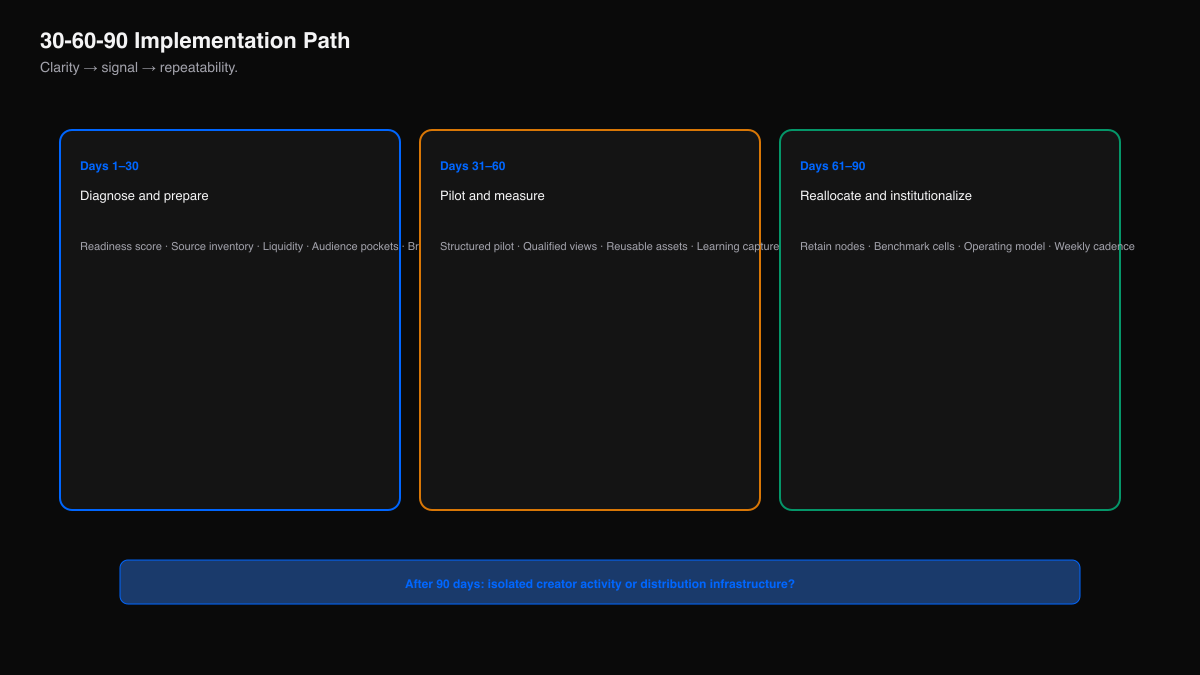
A Practical 30-60-90 Day Implementation Path
For a company that wants to act now, the path is not complicated. It only requires discipline.
Days 1–30: Diagnose and prepare
- Complete the Distribution Readiness Score.
- Build the Source Content Inventory.
- Score Content Liquidity.
- Define target audience pockets.
- Select one or two priority distribution surfaces.
- Identify initial creator node types.
- Draft claim zones and prohibited claims.
- Define qualified view and qualified outcome rules.
- Choose the first entry mechanism.
- Build the campaign brief.
The goal of the first 30 days is clarity, not scale.
Days 31–60: Pilot and measure
- Activate a controlled creator cohort.
- Run one structured clipping or creator-powered distribution pilot.
- Track performance by source asset, creator, platform, format, hook, and claim zone.
- Record review time, rejection reasons, approval rates, and payout outcomes.
- Separate raw views from qualified views.
- Identify reusable assets.
- Capture validated learning.
- Run a creator and operator retrospective.
The goal of days 31–60 is signal.
Days 61–90: Reallocate and institutionalize
- Reallocate budget toward winning source assets, creators, hooks, and surfaces.
- Retain strong creator nodes.
- Remove or retrain weak nodes.
- Update briefs, claims, and review rules.
- Build benchmark cells from the first cycle.
- Decide whether to build, buy, agency-support, or hybridize.
- Establish weekly or biweekly operating cadence.
- Define ownership for governance and measurement.
The goal of days 61–90 is repeatability.
After 90 days, the company should know whether it is running isolated creator activity or building distribution infrastructure.
The Call to Action
Do not finish this book and create another folder of notes you never use.
Get the New Attention Economy Implementation Kit. It includes:
- The complete downloadable PDF edition.
- Distribution Readiness Score worksheet.
- Source Content Inventory.
- Content Liquidity worksheet.
- Clipper Vetting Scorecard.
- Campaign Brief template.
- Red, Yellow, and Green Claim Zone worksheet.
- Clip Quality Score.
- Campaign economics and benchmark-cell calculator.
- Campaign retrospective.
- 30-60-90 implementation calendar.
The kit is unlocked with your email and phone number so Clipur can deliver the files, identify which implementation path fits you, and follow up about relevant help. The form should state that clearly and request consent rather than hiding the purpose.
After unlocking the kit, make the buyer decision:
- Use self-serve infrastructure when the test is narrow, the risk is low, and your team can write the brief, supply the content, approve quickly, and interpret the result.
- Request a managed distribution audit when the launch is commercially important, the budget is meaningful, the platform mix is complex, or you expect Clipur to own strategy, creator activation, quality control, reporting, and the continuation plan.
If neither path fits, keep the toolkit and build readiness before spending.
The recommended primary button is:
Get the Book + Distribution Toolkit
The next question is not whether you need more content.
It is:
What distribution capability will remain after your next campaign ends?
Build that.
Final Operating Summary
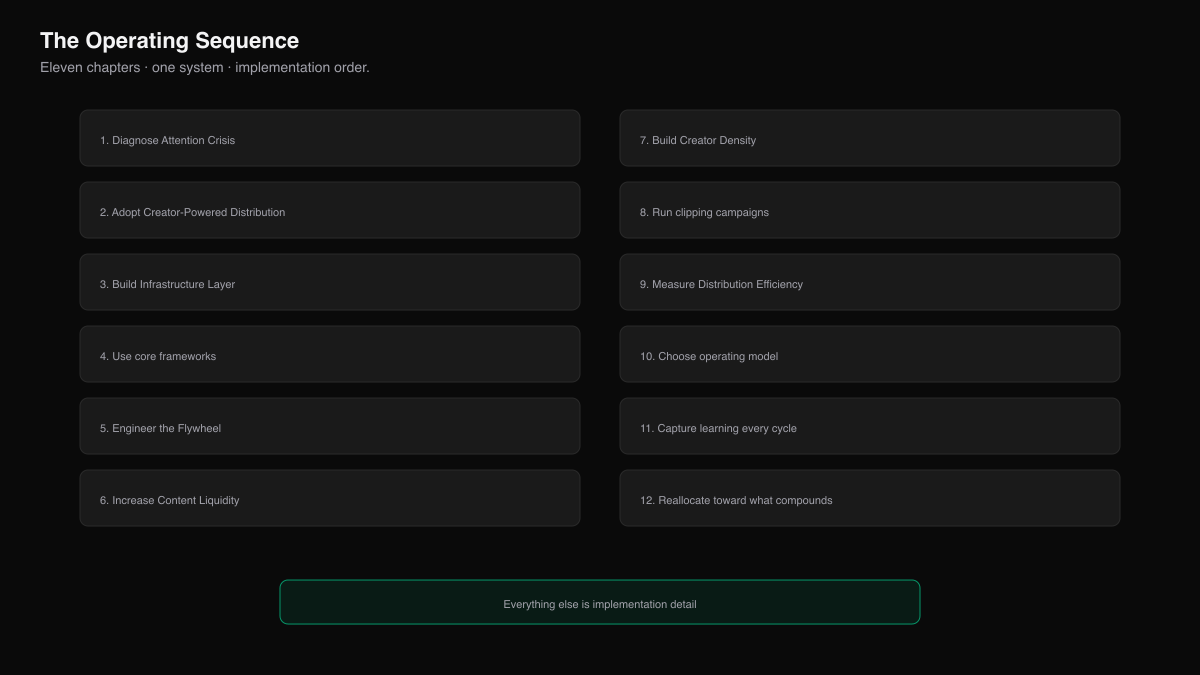
For reference, the book can be compressed into one operating sequence:
- Diagnose the Attention Crisis.
- Adopt Creator-Powered Distribution as the category model.
- Build or access a Distribution Infrastructure Layer.
- Use the core frameworks to diagnose constraints.
- Engineer the Distribution Flywheel.
- Increase Content Liquidity and Content Surface Area.
- Build qualified Creator Density.
- Use clipping campaigns as a high-leverage entry mechanism where appropriate.
- Measure Distribution Efficiency instead of only cheap reach.
- Choose the right build, buy, agency, or hybrid operating model.
- Capture learning every cycle.
- Reallocate toward what compounds.
That is the operating system.
Everything else is implementation detail.
Evidence and endnotes
- Digital advertising market: IAB and PwC, *Internet Advertising Revenue Report: Full Year 2025*, published April 2026. Supports the $294.6 billion U.S. internet advertising revenue figure and 13.9% year-over-year growth. Primary source.
- Creator advertising market: IAB, *2025 Creator Economy Ad Spend & Strategy Report*, published November 2025. Supports the $37.1 billion 2025 estimate, $43.9 billion 2026 estimate, and buyer challenges involving creator selection, measurement, standards, and tools. Primary source.
- Social-media use and fragmentation: Pew Research Center, *Americans’ Social Media Use 2025*, published November 2025. Supports the claim that U.S. adults use a varied platform mix with different adoption patterns. Primary source.
- Global social-media identities and use: DataReportal, *Global Social Media Statistics*, accessed June 2026. Figures refer to reported user identities and should not be read as guaranteed unique individuals. Source.
- U.S. endorsement and disclosure guidance: Federal Trade Commission, *Endorsements, Influencers, and Reviews*. Primary guidance.
- Formal U.S. endorsement guides: Electronic Code of Federal Regulations, 16 CFR Part 255, *Guides Concerning Use of Endorsements and Testimonials in Advertising*. Primary law and guidance source.
- Anonymized campaign A—time-sensitive speculative launch: Clipur internal campaign report and client-supplied launch reporting, 2026, on file with the author. Supports 150+ creators activated, 10M+ reported views, and reported presale movement from approximately $300,000 to more than $1.5 million. Client identity withheld. These figures do not establish financial causation, endorsement, or future performance.
- Anonymized campaign B—regulated financial-platform livestreams: Clipur internal reporting snapshot, 2026, on file with the author. Supports 536 submitted clips, 185 approved, 119 filtered, 232 pending, 135 activated accounts, 507,400 approved reach, approximately 156,000 pending views, and a 10,700-view top approved clip. The report measured content distribution, not deposits, trading volume, revenue, or conversion.
- Anonymized campaign C—sports-related application launch: Clipur internal campaign and referral report, one-week 2026 launch window, on file with the author. Supports thousands of posts or clips, millions of views, 18,500+ reported registrations, and top-20 referral performance. The published materials do not provide fully loaded cost, revenue, retention, or proof that every registration came from clipping.
- Evidence policy: Internal results are labeled as reported or measured according to the available record. Named clients, logos, screenshots, and testimonials require written permission before publication. When permission is absent, the book uses anonymized descriptions and preserves the material measurement limitations.
- Founder origin and early operating workflow: Founder meeting transcript, February 5, 2026, on file with the author. Supports the account of teaching early community members, coordinating thousands of clips through Telegram and Google Sheets, moving the workflow into Notion and multiple databases, and building the product to solve the resulting coordination problem. Other participants and private commercial details are omitted.
- Creator-incentive and budget audit: Founder operating meeting transcripts, June 4–5, 2026, on file with the author. Support the account of manual quality review, the approximate budget distribution, about $5,000 associated with accounts that were no longer active, the loss of strong contributors, and the restricted relaunch. Client and contributor identities are withheld. Figures are internal operating findings, not an independent audit.
- Review-backlog lesson: Operations meeting transcript, June 6, 2026, on file with the author. Supports the approximately 1,700-clip review queue, the estimated three to five reviewer requirement, and the limitations of a single engagement-based rejection rule. The threshold discussed in that meeting is not presented as current Clipur policy.
- Product-versus-managed-service lesson: Founder operating meeting transcript, June 9, 2026, on file with the author. Supports the account of no initial product-led sales, the subsequent roughly tenfold week-over-week revenue increase after selling managed execution, and the range of operating roles the team was carrying. The episode illustrates where customer value resided at that stage; it is not evidence that software or service is universally superior.
- Revenue-versus-recurrence lesson: Founder operating meeting transcripts, July 1 and July 15, 2026, on file with the author. Support the account of more than $100,000 in 30-day revenue, the immediate correction that this was not ARR, the period of complete customer churn, and the weak client handoff. Figures are founder-reported internal operating data and are used to explain recurrence, not to claim audited financial performance.
- Public category responsibility: Founder strategy meeting transcript, February 9, 2026, on file with the author. Supports the author's decision to become a public advocate for legitimate clipping standards and economic opportunity. Private participants, geographic examples, and investment discussions are omitted.
- MVP-versus-capability lesson: Clipur internal MVP requirements document, March 30, 2026, and founder product-review transcripts from February 2 and March 30, 2026, on file with the author. Support the enabled-feature list, the “no safeguard” annotation, the 12- to 16-hour operating workload, and the distinction between a demonstration-ready workflow and dependable infrastructure. Developer identities and current architecture details are omitted.
- Client-visibility and lifecycle lesson: Founder product-review transcript, February 16, 2026, plus the July 2026 internal client-lifecycle operating document, on file with the author. Support the missing account-level brand view and the later ten-stage client journey. The lifecycle document is an internal operating standard, not a public service-level guarantee.
- Responsible automation lesson: Founder product-workflow transcripts from January 27 and February 16, 2026, plus the July 2026 self-serve product requirements, on file with the author. Support the daily manual performance tracking, the decision not to force instant settlement, the estimated 20–30% workflow reduction from submit-and-pay, the plan to learn from manual approvals before expanding AI decisions, and the continued use of lightweight campaign review. Draft prices, margins, and technical details are omitted because commercial and product terms can change.
Read the whole book
The New Attention Economy: The Distribution Manifesto, 11 chapters, free to read and share.
Related courses
Distribution breakdowns
Related Clipipedia terms
Creator-Powered Distribution
Creator-powered distribution is a model where a network of independent creators publishes brand content across their own accounts, multiplying reach far beyond a brand's owned channels.
Distribution Infrastructure
Distribution infrastructure is the repeatable system, network, tooling, and operations, behind continuous reach.
Distribution Efficiency
Distribution efficiency measures how much qualified attention, asset, learning, and outcome value a system produces per unit of fully loaded cost.
Campaign Readiness
Campaign readiness is the degree to which source content, creator supply, governance, and measurement are ready before a clipping campaign launches.
Clipping Campaign
A clipping campaign is a coordinated effort that turns existing long-form content into short, platform-native clips and distributes them at scale across social media to maximize reach and impressions.
When you are ready to apply it
Ready to launch a campaign?
Use Clipur to turn existing content into distributed short-form reach.