
The Distribution Manifesto
Chapter 1 of 11 · 16 min read
Why Clipping Looks Like a Scam
The Attention Problem Most Businesses Misdiagnose
The argument
I understand why people think clipping is a scam.
They have seen anonymous accounts steal content, paste captions over it, farm engagement, inflate views, and call the result marketing. They have seen clipping programs pay for volume without caring where the views came from. They have watched low-quality editors turn a good speaker into a cheap-looking content farm. If that is your definition of clipping, your skepticism is justified.
Clipur did not begin as a software idea. It began because I needed clipping.
I had a small group of people who showed up to almost every stream I did. I believed clipping was going to become a real market, so I started teaching them how to do it. I did not offer them jobs or promise them money. I was solving an immediate problem with people who already understood the content.
Then companies began asking whether they could work with that group.
The demand arrived before the operating system. I coordinated thousands of clips through Telegram and Google Sheets. That became unmanageable, so I moved the process into Notion. One workspace became seven databases. Then I built a dashboard on top of them.
Then that sucked too.
From the outside, the workflow looked organized. Behind it, I was often working 12- to 16-hour days to keep the pieces connected.
Each workaround made one part of the process look more organized while leaving the real problem intact. We still had to route source material, explain the brief, recruit the right people, review submissions, validate performance, resolve disputes, and pay everyone correctly. The editing was visible. Coordination was the product.
That is why I began building the platform: first to solve my own operating problem, then because I realized other operators had the same one. Clipur grew from scar tissue, not a pitch deck.
That history did not stop me from getting the system wrong. If anything, early demand made it easier to believe that access to a crowd was the same thing as dependable fulfillment.
I learned the difference by losing real money and a client I wanted badly.
I had landed a top-five podcaster. It was the kind of logo that could have changed the trajectory of the business. Instead of treating fulfillment as the product, I treated winning the deal as the finish line. I did not have enough high-quality clippers. I did not enforce a strong creative standard. Some of the people producing and distributing clips relied on engagement-farming tactics that made the work look artificial.
The campaign did not fail because short-form content was useless. It failed because I had confused access to clippers with a clipping system.
The client left. I lost the $2,500 connected to the deal. The money hurt, but the more expensive loss was trust. I had proven the skeptic's case for them: clipping without quality, governance, platform judgment, and accountability looks exactly like a scam.
That failure changed what I believed the business was.
An edited clip is not distribution. A group of clippers is not automatically a network. A large view count is not automatically a result. The real product is the system that connects source content, capable people, platform-native packaging, quality control, incentives, measurement, and the next decision.
This book is about building that system.
The central problem in modern distribution is not that people stopped paying attention. The problem is that dependable access to relevant attention has become harder to engineer through legacy channels alone. Audiences are spread across more platforms, creators, communities, feeds, recommendation systems, private channels, and trust contexts than most companies are built to manage.
Distribution has shifted from a channel-buying problem to an operating-system problem.
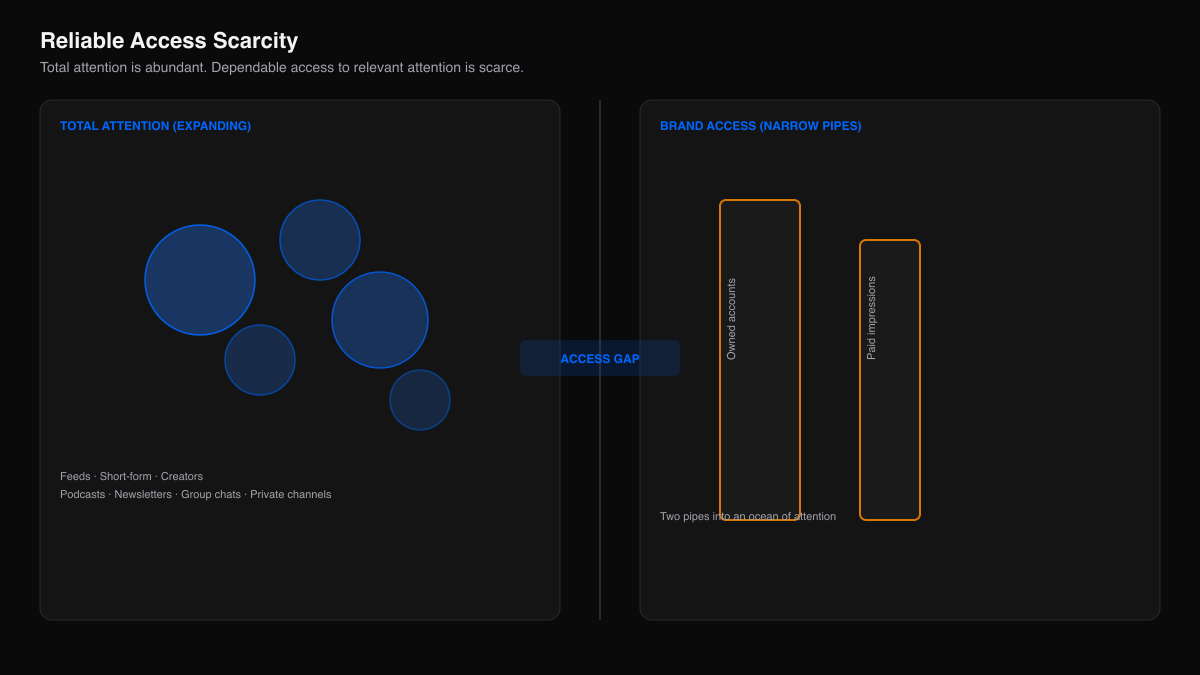
Attention is not scarce. Reliable access to the right attention is scarce.
That is the foundation of this book.
Who this book is for
I wrote this for the person who owns the result and can authorize the investment.
The primary reader is a business owner, founder, CEO, CMO, growth leader, or agency principal with a real offer and real customers—typically someone already doing at least $10,000 per month in business. You have source content or the ability to create it. Your audience spends time on social platforms. You can approve work quickly. Most importantly, you can fund a controlled distribution test without putting payroll or the company at risk.
If a several-thousand-dollar test would create a financial emergency, do not buy a managed distribution program yet. Build your source-content inventory, clarify the offer, and use the self-serve tools first. Distribution amplifies a functioning business; it does not rescue one that cannot afford to learn.
Within 30 days, this book should help you:
- Diagnose whether your constraint is content, creator supply, workflow, measurement, governance, or distribution itself.
- Choose a self-serve, managed, in-house, agency, or hybrid operating model based on the outcome and the risk.
- Launch or commission one controlled campaign with a defined brief, budget, approval path, measurement plan, and continuation decision.
Clippers and aspiring agency owners can still use the frameworks, but this edition makes decisions from the buyer's side of the table. It will not promise that clipping fixes a weak offer, guarantees virality, or makes every channel cheaper than paid advertising. It will help you determine when clipping is useful, when it is dangerous, what good execution requires, and whether the result justified another dollar.
The Strategic Error: Misdiagnosing the Failure
Most organizations misdiagnose distribution failure.
When reach declines, they say the content is weak. When ad performance softens, they say the creative is tired. When influencer campaigns underperform, they say the creator was wrong. When organic posts fail to move, they say the platform is dead. When a campaign generates views but not business results, they say the audience is low quality.
Sometimes those diagnoses are correct. Often they are incomplete.
A content team can create strong source material and still fail to distribute it. A paid media team can write competent ads and still be trapped in a saturated auction. A founder can have useful insights and still publish them through too few surfaces. A creator campaign can generate impressions and still produce no reusable learning. A brand can have market demand and still lack a system for routing its message through the environments where that demand is forming.
The failure is often not content. It is not even channel selection. It is distribution architecture.
Legacy distribution treats every channel as a separate operating lane. Paid acquisition has its dashboard. Organic social has its calendar. Influencer marketing has its talent roster. SEO has its keyword map. Email has its list. Community has its manager. PR has its agency. Repurposing has its editor. Each function may be useful, but the system is fragmented.
The audience does not experience the brand that way.
The audience moves through feeds, search interfaces, Discord servers, group chats, podcasts, creator videos, livestreams, newsletters, comments, recommendations, and screenshots. They do not care which budget center produced the message. They encounter the brand as a sequence of distributed impressions, most of which are mediated by platforms or people the brand does not fully control.
That mismatch is the Attention Crisis.
The Old Distribution Assumption
The old assumption was simple:
If the product is good and the company produces enough content or buys enough media, the market will eventually notice.
For a long time, this assumption was operationally useful. A company could pick a dominant channel, build an audience, run ads, hire an agency, sponsor influencers, publish blog posts, or launch a newsletter. The work was difficult, but the model was legible. Channels had clearer boundaries. Media buying was more predictable. Organic reach had a more direct relationship to follower count. Influencer partnerships were novel enough to generate outsized attention. Search captured intent before social feeds absorbed so much discovery behavior.
That world did not disappear.
Paid ads still work. Organic content still works. Search still works. Email still works. Influencer partnerships still work. Community still works. PR still works. The argument of this book is not that legacy channels are dead. That claim would be both lazy and false.
The evidence points in the opposite direction. IAB reported that U.S. internet advertising revenue reached $294.6 billion in 2025, up 13.9% year over year. Social advertising alone reached $117.7 billion, while digital video reached $78 billion. Paid media is not disappearing. It is becoming more competitive, more automated, more performance-driven, and more operationally demanding. Source: IAB/PwC, 2025 Internet Advertising Revenue Report.
The problem is not that the old channels stopped functioning. The problem is that no isolated channel can be assumed to carry the full distribution burden.
The new constraint is not whether a tactic can produce results. The constraint is whether the organization can coordinate enough distribution surfaces, creator participation, content packaging, measurement, and reallocation to keep marginal attention efficient.
A company that treats distribution as a collection of disconnected tactics will eventually experience the same pattern:
- Paid media gets more expensive or more creative-hungry.
- Organic posting becomes less predictable.
- Influencer deals produce uneven outcomes.
- Repurposing creates output but not necessarily reach.
- Search becomes more competitive and less controllable.
- Content volume increases faster than qualified attention.
- Teams conclude they have a “content problem” when they actually have a distribution infrastructure problem.
Attention Is Abundant. Reliable Access Is Scarce.
The phrase “attention crisis” can be misleading. It sounds like people are consuming less media. That is not the actual condition.
People are consuming enormous amounts of digital media. The global media environment is not empty. It is overfilled. Feeds, short-form video, creator channels, group chats, newsletters, podcasts, livestreams, private communities, search interfaces, and recommendation systems have expanded the total surface area of media consumption.
DataReportal reported 5.79 billion social media user identities at the start of April 2026 and estimated that the typical social media user actively uses or visits 6.5 platforms each month. It also estimated average social media usage at 18 hours and 36 minutes per week, including social networks and online video platforms. “User identities” are not necessarily unique individuals. Source: DataReportal, Global Social Media Statistics.
The crisis is access.
A company can no longer assume that publishing from its owned account reaches the audience it built. It can no longer assume that buying impressions produces trust. It can no longer assume that one creator partnership transfers credibility predictably. It can no longer assume that one content format travels across every platform unchanged. It can no longer assume that a quarterly campaign calendar is fast enough for a feed environment where formats, memes, incentives, and platform behavior change continuously.
Pew Research Center’s 2025 U.S. social media research shows the fragmentation clearly. YouTube and Facebook remain broad platforms, but U.S. adults also use Instagram, TikTok, WhatsApp, Reddit, Snapchat, X, Threads, Bluesky, and other platforms at different rates across age, demographic, and behavioral segments. Source: Pew Research Center, Americans’ Social Media Use 2025.
That means the strategic challenge is not merely “where is the audience?”
The strategic challenge is:
How do we build a system that can continuously create, route, test, amplify, and learn from many attention surfaces at once?
This is the premise of distribution infrastructure.
Structural Failure 1: Channel Dependency
Most distribution systems are overexposed to a small number of channels.
A company may depend on Meta ads, Google search, a founder’s LinkedIn account, one newsletter, one podcast, one influencer relationship, one creator partnership, or one platform algorithm. This creates Platform Dependency Risk: strategic fragility caused by dependence on a concentrated distribution source.
Channel dependency is not always visible when performance is strong. In fact, it is easiest to ignore when a channel is working. A high-performing ad account creates confidence. A founder’s account with strong reach creates confidence. A dominant SEO position creates confidence. A creator partnership that performs well creates confidence.
The issue is not whether the channel works now. The issue is whether the organization can survive and adapt when that surface becomes more expensive, more crowded, more regulated, more automated, less trusted, less measurable, or less available.
A resilient distribution system should not depend on one surface. It should create many surfaces.
That does not mean every brand must be everywhere. Surface area without relevance creates noise. The point is to create a portfolio of relevant surfaces, then build the operational capacity to route content across them.
The practical question is:
If our top distribution source weakened by 40% next quarter, what system would absorb the shock?
If the answer is “we would post more” or “we would spend more,” the company does not yet have distribution infrastructure. It has channel dependency with emergency tactics.
Structural Failure 2: Content Without Multiplication
Many teams have learned to produce more content. Fewer have learned how to multiply distribution.
A podcast becomes one YouTube upload. A webinar becomes one replay page. A founder insight becomes one LinkedIn post. A customer story becomes one case study. A keynote becomes one blog post. The content exists, but its surface area is narrow.
Repurposing partially solves this. It turns one asset into several assets. But repurposing is not the same as distribution.
Repurposing asks:
How many derivative assets did we create?
Distribution asks:
How many qualified surfaces did those assets reach, and what did we learn from them?
The distinction is critical.
A team can cut a long-form video into 20 short clips and still have a distribution problem if all 20 clips are posted through the same owned accounts, with no creator network, no audience segmentation, no incentive system, no performance feedback, and no capital reallocation process.
This is where the Distribution Multiplier becomes central.
The Distribution Multiplier measures how much additional distribution a source asset generates after it enters the system. A weak multiplier means content remains trapped inside owned surfaces. A strong multiplier means one source asset becomes many platform-native outputs, distributed through multiple creators, measured across multiple audiences, and fed back into future creative decisions.
The operator’s question becomes:
What is the distribution yield of this source asset?
Not every asset deserves multiplication. Some content should not travel. Some messages are too narrow, too sensitive, too generic, too compliance-heavy, or too weak. But when an asset is strategically valuable, the infrastructure should make multiplication possible.
Structural Failure 3: Trust Compression
Paid impressions can create reach, but they do not automatically create trust.
As audiences become more sophisticated, they classify messages by source. A claim from a brand account, an ad, a founder, a niche creator, a customer, a peer, an affiliate, and a community member can carry different trust weight even when the literal claim is identical.
Legacy distribution often treats impressions as interchangeable. Creator-powered distribution treats the source of the impression as part of the message.
This does not mean creators are always more trusted. It does not mean creator content automatically performs. It does not mean “authenticity” is a strategy. It means distribution strategy must account for trust context, not just reach.
Trust compression happens when a brand tries to force every message through channels where the audience applies a low-trust filter. The message may be correct. The offer may be useful. The product may be strong. But the source context weakens reception.
Creator-powered surfaces can help because they route messages through people and communities with existing context. But this only works when the creator, format, message, and audience fit. Paying a creator to repeat brand copy is not trust amplification. It is outsourced ad creative.
A mature system must distinguish:
- Raw reach
- Trust-adjusted reach
- Qualified attention
- Business outcome
The more expensive attention becomes, the more expensive it is to ignore trust.
Structural Failure 4: Slow Learning Loops
The most expensive distribution systems are not always the ones with the highest CPM. They are the ones that learn slowly.
If a team spends money, publishes content, or hires creators but cannot determine which hook, format, audience, creator type, or platform drove the result, the system cannot improve. Each campaign becomes a separate event rather than an input into a compounding learning loop.
Modern distribution advantage comes from learning rate.
A creator-powered distribution system should make the following visible:
- Which source assets generate the most clip potential
- Which hooks create the strongest early Attention Velocity
- Which creators produce qualified attention rather than empty reach
- Which platforms extend Content Half-Life
- Which messages retain trust across multiple creator surfaces
- Which incentives produce speed without sacrificing quality
- Which surfaces create useful downstream signals
- Which formats should receive more capital
Without that visibility, distribution remains episodic.
Slow learning loops often hide behind activity. The team is busy. Content ships. Creators post. Ads run. Reports get produced. But if the next campaign does not become structurally smarter than the last campaign, the system is not compounding.
The most important output of a distribution system is not views. It is reusable learning that can be converted into better distribution.
Structural Failure 5: Creative Fatigue Without Creative Supply
Modern paid media and organic distribution both demand more creative variation than most teams can produce internally.
The issue is not simply volume. It is variation under governance.
A performance team may need many hooks, angles, intros, thumbnails, captions, claims, proof points, creator styles, and platform-native variants. A brand team may need consistency, accuracy, compliance, and quality control. A content team may need time to produce source material. A legal or compliance team may need claims discipline. A founder may need leverage.
These needs collide.
Without infrastructure, teams respond to creative fatigue in predictable ways:
- They ask internal editors to produce more assets.
- They refresh ad creative without changing the distribution system.
- They copy competitor formats.
- They hire creators one at a time.
- They increase posting frequency.
- They lower quality standards to move faster.
That can work briefly. It does not solve the underlying problem.
The infrastructure answer is to build a governed creative supply network. Creator-powered distribution expands the number of people who can create, package, and distribute content while preserving rules for claims, brand safety, rights, and measurement.
The advantage is not just more creative. It is more creative variation attached to a learning loop.
Diagnostic: Content Problem or Infrastructure Problem?
Most teams diagnose too late and too vaguely. They say:
- “Our content is not working.”
- “Our ads are too expensive.”
- “Organic reach is dead.”
- “Influencers do not convert.”
- “We need more top-of-funnel.”
- “The algorithm changed.”
These may be true. But they are not precise enough to act on.
Use this diagnostic instead.
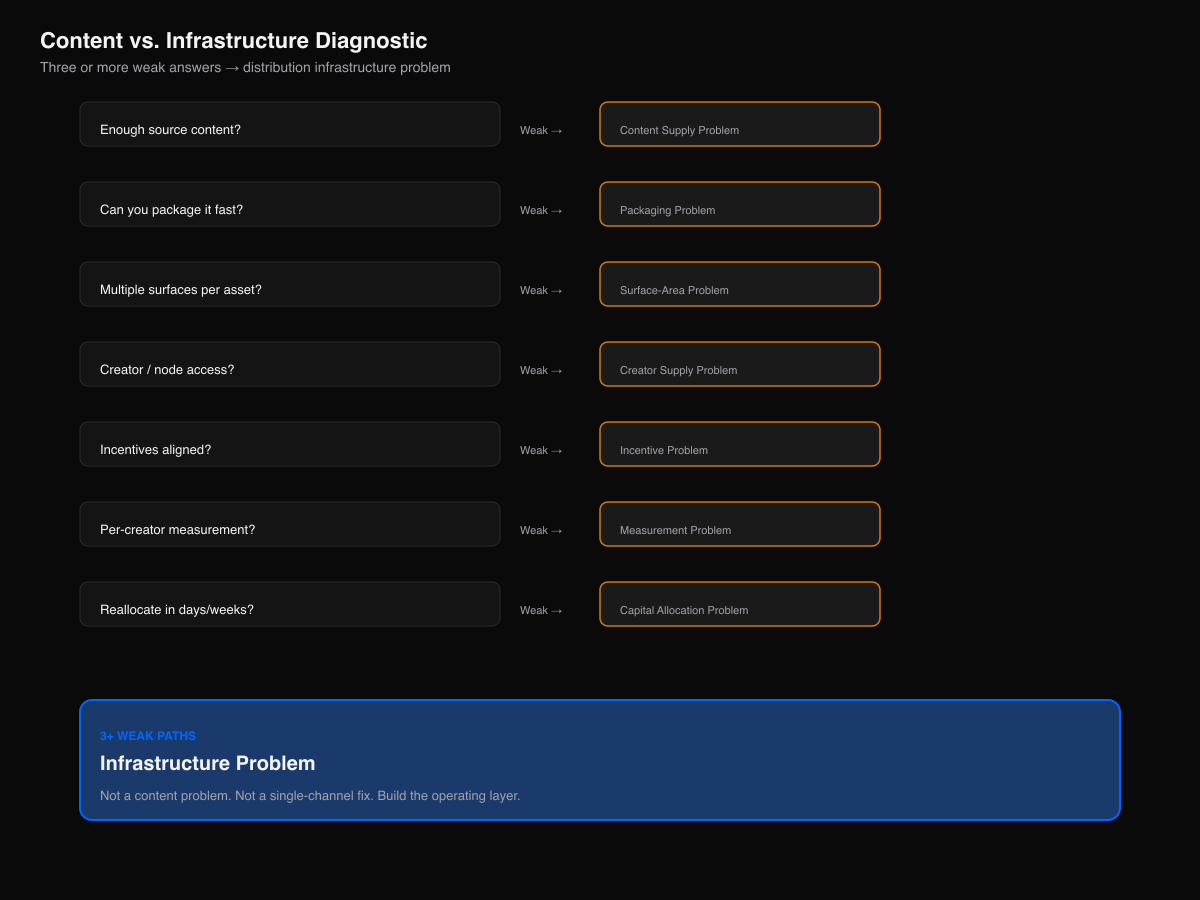
Test 1: Source Content Inventory
Do you have enough raw material worth distributing?
If not, you have a content supply problem.
Test 2: Packaging Capacity
Can you turn source material into platform-native assets quickly and repeatedly?
If not, you have a packaging problem.
Test 3: Surface Area
Does each source asset create multiple relevant distribution surfaces?
If not, you have a surface-area problem.
Test 4: Creator Access
Do you have access to creators, clippers, ambassadors, affiliates, niche accounts, or community nodes that can distribute into relevant audiences?
If not, you have a creator supply problem.
Test 5: Incentive Design
Do creators know what behaviors are rewarded, and do those rewards produce the right balance of speed, quality, compliance, and audience fit?
If not, you have an incentive problem.
Test 6: Measurement Loop
Can you see which creator, hook, format, asset, platform, and surface created the result?
If not, you have a measurement problem.
Test 7: Reallocation Speed
Can you move budget, attention, and briefs toward what is working within days or weeks, not months?
If not, you have a capital allocation problem.
If three or more tests fail, the issue is not simply content quality. The issue is missing distribution infrastructure.
The Operator Shift
The old distribution operator asked:
What channel should we use?
The new distribution operator asks:
What system routes this message through the right surfaces, with the right creators, under the right incentives, and with the right measurement loop?
This is a different job.
It requires the operator to think like a systems designer, not only a campaign manager. The operator must manage content supply, creator supply, incentives, platform-native packaging, rights, approval speed, measurement, and reallocation. The operator must also decide when a result is a signal and when it is noise.
The new operator does not worship virality. Virality can be useful, but it is not the foundation. The foundation is repeated learning.
A viral clip is an event. The durable advantage is a system that repeatedly discovers which clips, creators, formats, platforms, and messages deserve more distribution.
This is why distribution infrastructure is the correct response to the Attention Crisis. It converts attention from a series of disconnected wins into a compounding operating system.
Read the whole book
The New Attention Economy: The Distribution Manifesto, 11 chapters, free to read and share.
Related courses
When you are ready to apply it
Ready to launch a campaign?
Use Clipur to turn existing content into distributed short-form reach.