
The Distribution Manifesto
Chapter 6 of 11 · 15 min read
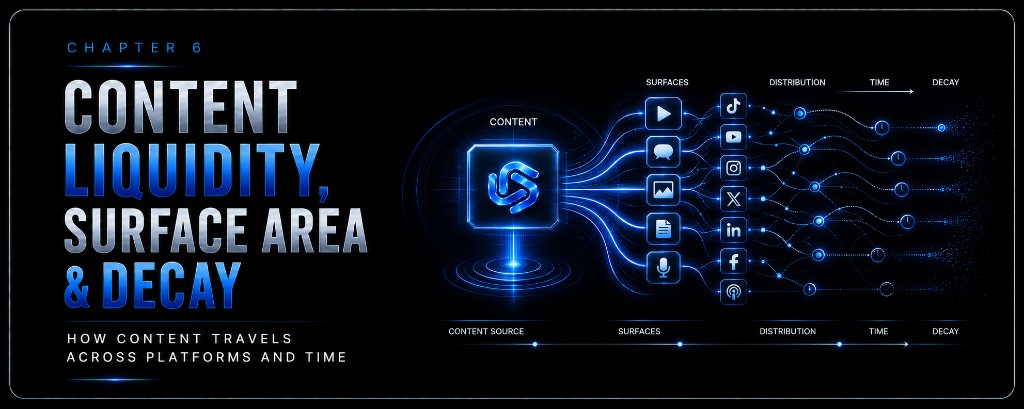
Content That Travels
Liquidity, Surface Area, and Decay
The argument
The Distribution Flywheel cannot compound unless content can travel.
A creator-powered system does not win because a brand publishes more assets. It wins because the same source material can be converted into many credible, platform-native, creator-compatible, audience-specific distribution units without losing meaning, trust, or measurement integrity.
This chapter defines the content physics behind that system: Content Liquidity, Content Surface Area, and Content Decay. These are the properties that determine whether a content asset dies after its first publish, travels through a creator network, or becomes reusable distribution infrastructure.
The Content Travel Model
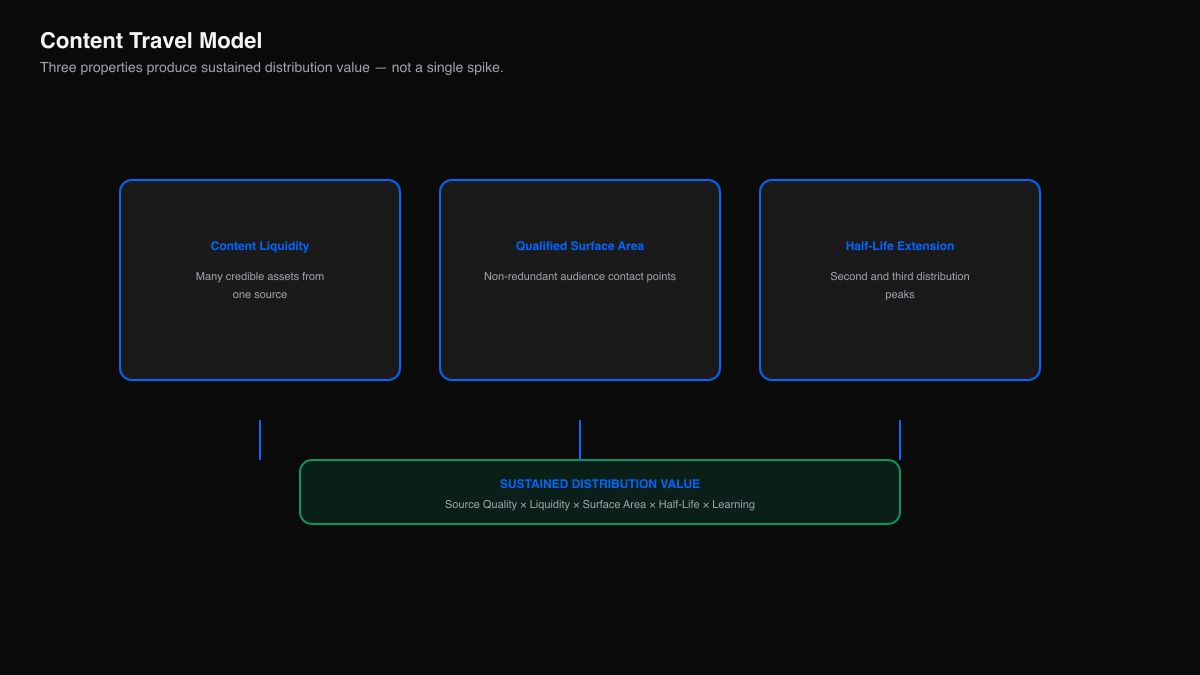
Content travels when three properties reinforce one another:
- Liquidity: the source material can be converted into useful distribution units.
- Surface Area: those units can appear credibly across multiple audience contact points.
- Half-Life Extension: those units can continue producing value beyond the first publishing window.
The directional model is:
Sustained Distribution Value = Source Quality x Content Liquidity x Qualified Surface Area x Half-Life Extension x Learning Capture
Each term matters.
- Source Quality is the inherent usefulness, specificity, credibility, novelty, entertainment value, or proof inside the original material.
- Content Liquidity is the ease with which that source can be converted into distribution-ready units.
- Qualified Surface Area is the number of credible audience contact points where the message can appear without becoming redundant or low-trust.
- Half-Life Extension is the additional value created by repackaging, rerouting, refreshing, and redistributing the asset over time.
- Learning Capture is whether each distribution event creates data that improves the next one.
The multiplication matters. High source quality with low liquidity creates trapped value. High liquidity with low source quality creates empty output. High surface area without context fit creates spam. Long half-life without learning creates recycled mediocrity.
Identify which assets deserve distribution investment, then engineer the conditions that let those assets travel. Maximizing every variable blindly only creates more output.
Content Liquidity
Content Liquidity is the ease with which source content can be converted into multiple distribution-ready assets without losing meaning, credibility, or audience relevance.
Liquid content has four traits:
- It contains separable units of value. A viewer can understand a clip, quote, carousel, thread, or creator post without needing the entire source asset.
- It supports multiple hooks. The same source can be framed around pain, proof, controversy, aspiration, tactical utility, status, identity, or entertainment.
- It can be made platform-native. The idea can adapt to short-form video, long-form video, text, image, carousel, newsletter, sales enablement, or course material.
- It preserves trust when repackaged. The claim does not become misleading when shortened, remixed, or placed in a new context.
Illiquid content may still be valuable. A dense technical memo, legal announcement, internal strategy call, or long founder monologue can contain important material. But if the material cannot be broken into self-contained assets, the distribution system must do more work before creators can use it.
The distinction is operational.
| Content Type | High-Liquidity Version | Low-Liquidity Version |
|---|---|---|
| Founder explanation | Clear thesis, examples, punchy contrast, usable proof. | Wandering context with no extractable claim. |
| Customer story | Specific before/after, credible obstacle, measurable result. | Vague praise with no concrete transformation. |
| Product demo | Visual problem, simple workflow, clear outcome. | Feature tour with no audience pain. |
| Podcast | Distinct segments, strong moments, tension, examples. | Long conversational drift with no sharp units. |
| Educational content | Framework, steps, decision rules, mistakes. | Abstract commentary with no operator action. |
| Market point of view | Category claim, evidence, enemy, new model. | Generic trend summary. |
Liquidity is not the same as simplicity. Some complex ideas are highly liquid because they can be broken into strong components. Some simple ideas are illiquid because they lack novelty, proof, or emotional charge.
A useful test:
Can ten creators look at this source asset and produce ten meaningfully different, credible distribution assets from it?
If yes, the asset has high liquidity.
If no, it may still be useful, but it needs stronger packaging before it enters the creator-powered distribution system.
Media Liquidity Is the Operational Layer
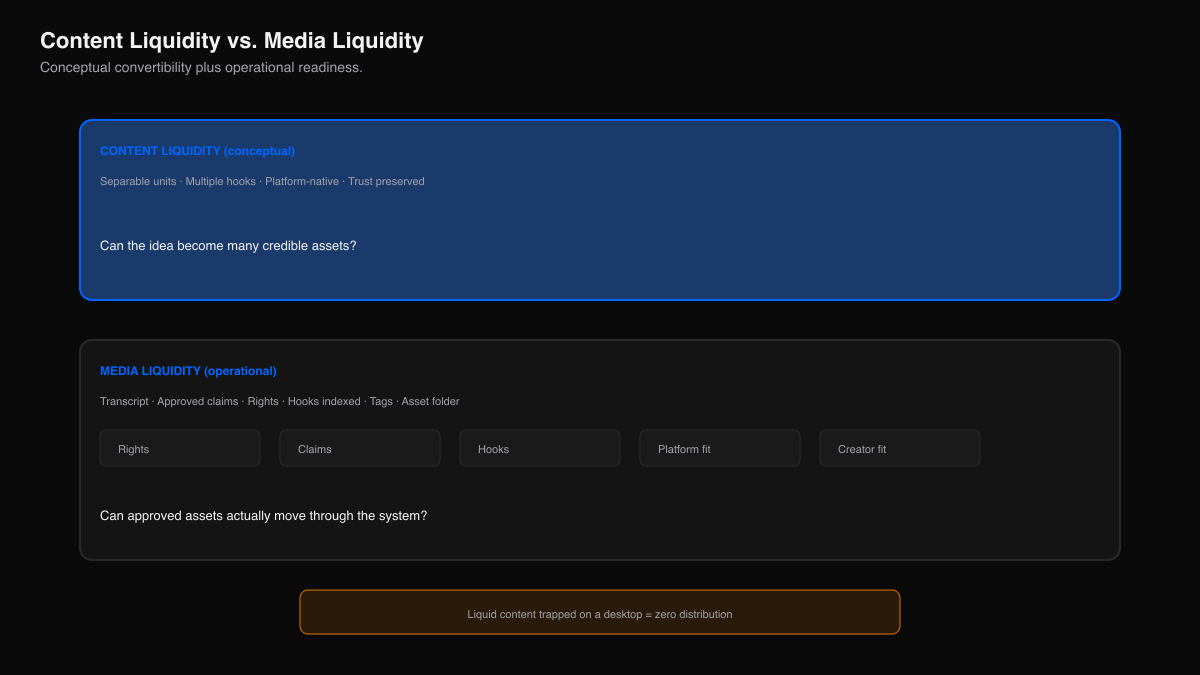
Content liquidity and media liquidity are related but distinct.
Content Liquidity describes the conceptual and narrative convertibility of the material.
Media Liquidity describes whether the files, rights, metadata, permissions, transcripts, cuts, captions, and assets are operationally ready to move through the system.
A source asset can be conceptually liquid but operationally illiquid.
Example: a founder gives a sharp 45-minute talk full of strong clips. The ideas are excellent. But the file is buried in someone’s desktop, there is no transcript, no approved claims list, no rights status, no brand-safe cutdown, no creator brief, and no tagging. The content is liquid. The media is not.
A creator-powered distribution system needs both.
| Requirement | Content Liquidity Question | Media Liquidity Question |
|---|---|---|
| Source usefulness | Does this contain extractable value? | Can the source file be accessed quickly? |
| Repackaging | Can the idea become multiple assets? | Are clips, captions, thumbnails, and transcripts editable? |
| Rights | Can the claim be used safely in public? | Do we have permission to redistribute the media? |
| Creator usability | Can creators understand the angle? | Is there a brief, asset folder, and usage guidance? |
| Measurement | Can we test variants meaningfully? | Are assets tagged by source, hook, creator, platform, and date? |
Many teams overdiagnose creative weakness and underdiagnose media liquidity.
The problem is not always that the content is bad. Sometimes the content is trapped inside inaccessible workflows.
Creator-powered infrastructure should therefore include a Source Content Inventory. The inventory is not a folder of random assets. It is an indexed, tagged, rights-aware, distribution-oriented library of source material that can be converted into campaigns.
At minimum, every source item should include:
- Source title
- Source type
- Date created
- Owner
- Rights status
- Approved usage level
- Target audience
- Core claims
- Proof points
- Potential hooks
- Platform fit
- Creator fit
- Existing performance data
- Reuse status
- Expiration or review date
Without this inventory, half-life extension becomes accidental. With it, the distribution team can treat content like usable capital.
Atomic Content Units
An Atomic Content Unit is the smallest self-contained idea, claim, story, proof point, demonstration, contrast, objection, or emotional beat that can be turned into a distribution asset.
Creator-powered distribution depends on atomic units because creators do not distribute “content strategy.” They distribute units of meaning.
Examples:
| Atomic Unit Type | Description | Example Structure |
|---|---|---|
| Hook | Attention-opening premise. | “Most brands do not have a content problem. They have a distribution infrastructure problem.” |
| Claim | A clear assertion. | “The first publish is no longer the full life of the asset.” |
| Contrast | Old way vs. new way. | “Legacy teams publish once. Infrastructure teams route content repeatedly.” |
| Proof | Evidence, number, example, result, or demonstration. | “One webinar can become a clip portfolio, sales asset, course module, and search article.” |
| Story | Sequence with tension and resolution. | “A founder records one customer teardown and discovers five repeatable objections.” |
| Decision rule | Operator guidance. | “If a source asset cannot generate at least three hooks, do not send it to creators yet.” |
| Objection answer | Response to buyer or audience resistance. | “No, creator-powered distribution is not just reposting. The point is measurable routing through trusted nodes.” |
| Visualizable moment | Something that can become a diagram, screen recording, meme, or carousel. | “Content half-life as a decay curve with redistribution peaks.” |
A source asset with many atomic units has high Hook Density, Proof Density, and Repackaging Potential.
A source asset with few atomic units may still have strategic value, but it should not be treated as a high-yield clipping source.
This distinction matters because distribution systems are capacity-constrained. Creators, editors, operators, and reviewers should not waste cycles trying to extract dozens of assets from source material that only contains two usable units.
The operational question is:
How many atomic units does this source asset contain, and which ones are worth distributing?
The answer determines whether the asset should become:
- One hero clip
- A small clip batch
- A full clip portfolio
- A long-form article
- A sales enablement asset
- A Clipper University lesson
- A search/GEO page
- A creator campaign
- A future source asset for additional distribution
- Or no public asset at all
Clip Portfolios, Not Random Clips
A Clip Portfolio is a coordinated set of short-form or repurposed assets derived from one or more source assets, designed to test multiple hooks, formats, creator angles, audience pockets, and platform surfaces.
The portfolio concept matters because one clip rarely tells the operator enough.
A single clip can outperform or underperform for reasons that are hard to isolate:
- The hook was strong.
- The creator was strong.
- The topic was timely.
- The platform surface was favorable.
- The caption improved performance.
- The opening visual carried the asset.
- The audience fit was better than expected.
- The same idea would have worked better with a different frame.
A portfolio gives the system comparative data.
For example, one source asset might produce a portfolio with:
| Variant Type | Purpose |
|---|---|
| Pain-point hook | Tests whether the audience feels the problem. |
| Contrarian hook | Tests whether the market responds to tension. |
| Proof-led hook | Tests whether evidence drives attention. |
| Founder POV | Tests personal authority and category leadership. |
| Tactical tutorial | Tests practical utility. |
| Customer transformation | Tests social proof. |
| Meme or entertainment frame | Tests cultural fit and shareability. |
| Sales-objection frame | Tests buyer readiness. |
The portfolio is not a volume tactic. It is a learning instrument.
A good portfolio should answer:
- Which hooks create initial attention?
- Which angles retain attention?
- Which creators can carry which messages credibly?
- Which audience pockets respond to which proof?
- Which platforms extend the asset’s half-life?
- Which formats create reusable learning?
- Which messages should be retired, refreshed, or scaled?
When operators treat clips as isolated outputs, the campaign becomes a content factory. When they treat clips as a portfolio, the campaign becomes a market-learning system.
Content Surface Area
Content Surface Area is the total number of meaningful audience contact points created from a source idea, asset, campaign, or content library across formats, creators, platforms, communities, and time windows.
Surface area is not the same as distribution volume.
Posting the same asset to ten accounts that reach the same audience with the same framing is not ten units of meaningful surface area. It is partial duplication.
Qualified surface area requires three conditions:
- Audience relevance: the asset reaches a pocket of people who plausibly care.
- Context fit: the asset belongs in the platform, creator, community, or moment where it appears.
- Message integrity: the asset remains accurate, credible, and non-spammy in that context.
A creator-powered system expands surface area by changing one or more of these dimensions:
| Dimension | Surface-Area Expansion Question |
|---|---|
| Format | Can the idea become a clip, carousel, thread, meme, article, email, sales asset, or lesson? |
| Creator Node | Which creators can carry the message with credibility? |
| Platform | Which platforms reward this format and audience context? |
| Audience Pocket | Which subgroups have different pains, language, or motivations? |
| Time Window | Should the idea launch now, resurface later, or become evergreen? |
| Context | What framing makes the message native to the environment? |
| Measurement | Can the system identify which surface created value? |
The strongest content assets have multiple valid travel paths.
A weak asset has one path: post once and hope.
A strong asset can become:
- A founder clip for LinkedIn
- A tactical clip for TikTok
- A proof-led short for YouTube Shorts
- A carousel for Instagram
- A thread for X
- A newsletter segment
- A sales follow-up asset
- A support article
- A Clipper University lesson
- A benchmark reference
- A future campaign brief
- A search-optimized article
- A creator prompt
That does not mean every asset should be everywhere. Surface-area expansion without context fit creates low-trust repetition. The job is to find qualified surface area, not maximum surface count.
Pew’s 2025 U.S. social media research is useful here because it shows that platform usage is not uniform. YouTube and Facebook remain broad platforms, while Instagram, TikTok, WhatsApp, and Reddit have grown in recent years, with usage patterns varying across demographics and frequency. DataReportal’s Digital 2026 work similarly emphasizes that user counts alone are not enough; reach, time spent, daily use, sessions, and platform preference all matter when analyzing social behavior. The implication for operators is direct: distribution planning should be surface-specific rather than platform-generic.
Content Decay Is Not Failure
Content Decay is the natural reduction in a content asset’s distribution velocity, attention potential, contextual relevance, or economic value over time.
Decay is not a moral problem. It is a media physics problem.
Most assets lose value for one or more reasons:
| Decay Type | What Declines | Typical Signal |
|---|---|---|
| Platform Decay | Feed recommendation and reach. | Attention velocity drops after the initial window. |
| Topical Decay | Timeliness. | The market stops caring about the event or trend. |
| Creative Decay | Novelty of the format or hook. | Similar assets stop performing. |
| Audience Decay | Incremental audience exposure. | The same audience has already seen the idea. |
| Context Decay | Fit with the current moment. | The framing feels dated or misaligned. |
| Operational Decay | Internal accessibility. | The team forgets the asset exists or cannot find it. |
| Claim Decay | Accuracy of the message. | Data, product details, or compliance language changes. |
The operator’s job is not to eliminate decay. That is impossible.
The job is to distinguish between four conditions:
- Fast decay, low residual value: let the asset expire.
- Fast decay, high residual value: repackage quickly.
- Slow decay, low activation: improve surface-area mapping.
- Slow decay, high residual value: turn the asset into infrastructure.
A trend clip may deserve fast distribution and fast retirement. A category framework may deserve repeated resurfacing for months or years. A product claim may require regular review. A customer proof asset may become more valuable when paired with a relevant objection or sales cycle.
Decay becomes dangerous only when teams cannot see it.
If the system measures only first-publish performance, it may discard assets that could have worked through different creators, contexts, or time windows. If the system treats every asset as evergreen, it may keep redistributing stale content and damage trust.
The point of the Content Decay Curve is not to make everything live forever. The point is to decide what should be refreshed, rerouted, recycled, or retired.
Content Half-Life
Content Half-Life is the amount of time it takes for a content asset to generate half of its total expected attention, engagement, or qualified distribution value.
In practice, there are several useful half-life views:
| Half-Life View | Question |
|---|---|
| Attention Half-Life | When does the asset generate half of its lifetime qualified views or impressions? |
| Engagement Half-Life | When does the asset generate half of its lifetime engagement? |
| Learning Half-Life | When does the campaign produce enough data to make useful optimization decisions? |
| Economic Half-Life | When does the asset generate half of its expected business value? |
| Strategic Half-Life | When does the idea stop being relevant to the company’s positioning? |
Creator-powered distribution changes the curve because the first publish is no longer the whole life of the asset.
Legacy owned publishing often creates one peak:
Publish → initial attention → decay
Creator-powered distribution can create multiple peaks:
Source asset → clip portfolio → creator posts → performance data → refreshed variants → new creators → new surfaces → evergreen reuse
This does not guarantee better performance. It creates the possibility of half-life extension.
The operator should ask:
- Did redistribution create incremental qualified attention, or only duplicated exposure?
- Did the second wave perform because of a new creator, new hook, new platform, or new time window?
- Did resurfacing improve learning, sales enablement, search presence, or creator retention?
- Did the asset remain accurate and brand-safe after repackaging?
- Did the cost of extension justify the incremental value?
Without those questions, half-life extension becomes indiscriminate recycling.
With those questions, it becomes a disciplined distribution capability.
The Decay Intervention Model
A Decay Intervention is an operational action taken to preserve, restore, redirect, or intentionally end the distribution value of a content asset.
There are six primary interventions:
| Intervention | Purpose | Use When |
|---|---|---|
| Repackage | Change the hook, structure, format, length, visual, or CTA. | The idea is still useful but the current asset is stale. |
| Reroute | Move the asset to a different creator, platform, community, or audience pocket. | Performance is weak in one surface but the audience fit may be stronger elsewhere. |
| Refresh | Update examples, data, proof, product language, or cultural context. | The core idea remains relevant but details have aged. |
| Remix | Combine the asset with another source, trend, creator POV, or proof point. | The asset needs new energy or stronger context. |
| Reinforce | Convert the asset into sales, education, support, SEO, GEO, or internal training material. | The asset has durable utility beyond feed performance. |
| Retire | Stop distributing the asset. | The claim is outdated, performance is exhausted, risk is high, or value is too low. |
These interventions should be tied to decision rules.
| Signal | Likely Action |
|---|---|
| Strong early attention, weak retention | Repackage the opening and improve structure. |
| Weak owned performance, strong creator fit | Reroute through creator nodes. |
| Strong old performance, outdated proof | Refresh. |
| Strong framework, low entertainment value | Reinforce through education, search, or sales. |
| High frequency, declining engagement, audience overlap | Reroute or retire. |
| Compliance uncertainty | Pause and review before any intervention. |
| No source clarity, no proof, weak hook density | Do not intervene; improve source content. |
A mature creator-powered system should review assets at three moments:
- Pre-launch: Should this asset enter distribution?
- Post-initial window: Should this asset receive a second wave?
- Library review: Should this asset become evergreen, be refreshed, or be retired?
This process turns decay management into an operating cadence.
Content Atomization Workflow
The workflow for turning source content into distribution infrastructure has eight steps.
Step 1: Inventory the source
Identify the source asset, owner, date, rights status, claims, audience, and strategic purpose.
Do not begin clipping until the asset has a minimum level of rights and claim clarity.
Step 2: Extract atomic units
Break the source into hooks, claims, proof points, stories, contrasts, objections, decisions, and visualizable moments.
The output is not a clip list yet. It is a unit-of-meaning list.
Step 3: Score liquidity
Use the Content Liquidity Score. Decide whether the source is not ready, packaging-only, campaign-ready, or high-liquidity.
Step 4: Build the clip portfolio
Convert the strongest units into a structured variant set. Include multiple hooks, formats, creator angles, and audience hypotheses.
Step 5: Map qualified surfaces
Create a surface-area map. Assign each variant to creator types, platforms, audience pockets, and time windows.
Step 6: Launch in waves
Do not publish every variant at once unless the campaign is deliberately designed as a launch burst. Use waves to preserve learning and avoid unnecessary audience saturation.
Step 7: Measure by path
Tag performance by source, atomic unit, hook, format, creator, platform, audience, and time window.
The objective is not only to report results. The objective is to learn which travel paths work.
Step 8: Intervene or retire
After the initial window, decide whether to repackage, reroute, refresh, remix, reinforce, or retire each asset.
The workflow should feed back into the Source Content Inventory. Every campaign should leave the library smarter than it was before.
Wave Design and Timing
A common mistake is distributing every variant as quickly as possible.
Sometimes speed is correct. Launches, events, news reactions, and trend-driven campaigns may require concentrated output. But many creator-powered campaigns should use waves.
Wave design controls learning and decay.
| Wave | Purpose | Typical Content |
|---|---|---|
| Wave 0: Internal Test | Validate claims, rights, packaging, and measurement. | Internal clips, paid test, small owned post. |
| Wave 1: Attention Test | Identify hooks, creators, and formats with early traction. | Broad hook variants, creator tests. |
| Wave 2: Optimization | Repackage around winners and route to better-fit nodes. | Improved clips, refined captions, stronger creator matches. |
| Wave 3: Surface Expansion | Move winning ideas into adjacent audiences and platforms. | Carousels, threads, sales assets, search pages, course modules. |
| Wave 4: Evergreen Reinforcement | Preserve durable value. | Library assets, lessons, articles, onboarding, recurring social. |
Wave design protects the system from two errors:
- Premature saturation: too many similar assets hit the same audience before the system learns.
- Premature retirement: strong ideas are abandoned because the first package or surface failed.
The operator should not think only in publish dates. The operator should think in distribution windows.
Read the whole book
The New Attention Economy: The Distribution Manifesto, 11 chapters, free to read and share.
When you are ready to apply it
Ready to launch a campaign?
Use Clipur to turn existing content into distributed short-form reach.