
The Distribution Manifesto
Chapter 7 of 11 · 17 min read
Clippers as a Distribution Network
How Quality, Incentives, and Trust Compound
The argument
The next major distribution channel is not a platform. It is a coordinated network of creators.
Legacy distribution treated attention as something a company could buy, rent, or publish toward from a central account. Creator-powered distribution treats attention as something that moves through many trusted nodes, each with its own audience context, format fluency, trust relationship, and publishing surface.
This chapter defines the creator network as a primary distribution channel. It explains why creator count is not enough, how Creator Density changes distribution capacity, how to vet and activate creator nodes, how to design incentives, how to control quality without destroying authenticity, and how to govern fraud, compliance, and retention.
The operating principle is simple:
A creator network is only valuable when it can produce repeatable, qualified, trusted distribution events under measurable governance.
Without that, it is just a list of people.
The client I could win but could not fully serve
I learned the supply-side constraint again after landing a top-ten trading app.
The client did not need another X-only campaign. It needed cross-platform fulfillment on Instagram and TikTok as well. I had proven that I could create activity around a market narrative, but I had not built enough dependable, platform-native clipper supply across all three environments.
An X clipper is not automatically an Instagram Reels operator. An Instagram editor is not automatically good at TikTok packaging. The pacing, caption behavior, visual conventions, account history, audience expectations, and publishing judgment differ. Treating every clipper as interchangeable hid the gap until the client expected fulfillment.
The problem was not sales. The problem was that sales had outrun Creator Density.
That experience created a rule I now take seriously:
Never promise platform coverage based on names in a database. Promise it only when qualified people have been tested, activated, and retained on that platform.
This chapter is the supply-side answer to that failure.
From Broadcasting to Networked Distribution
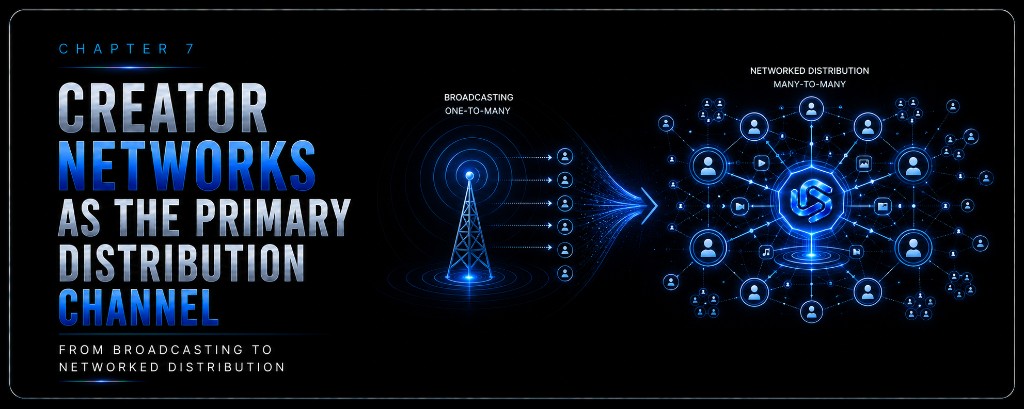
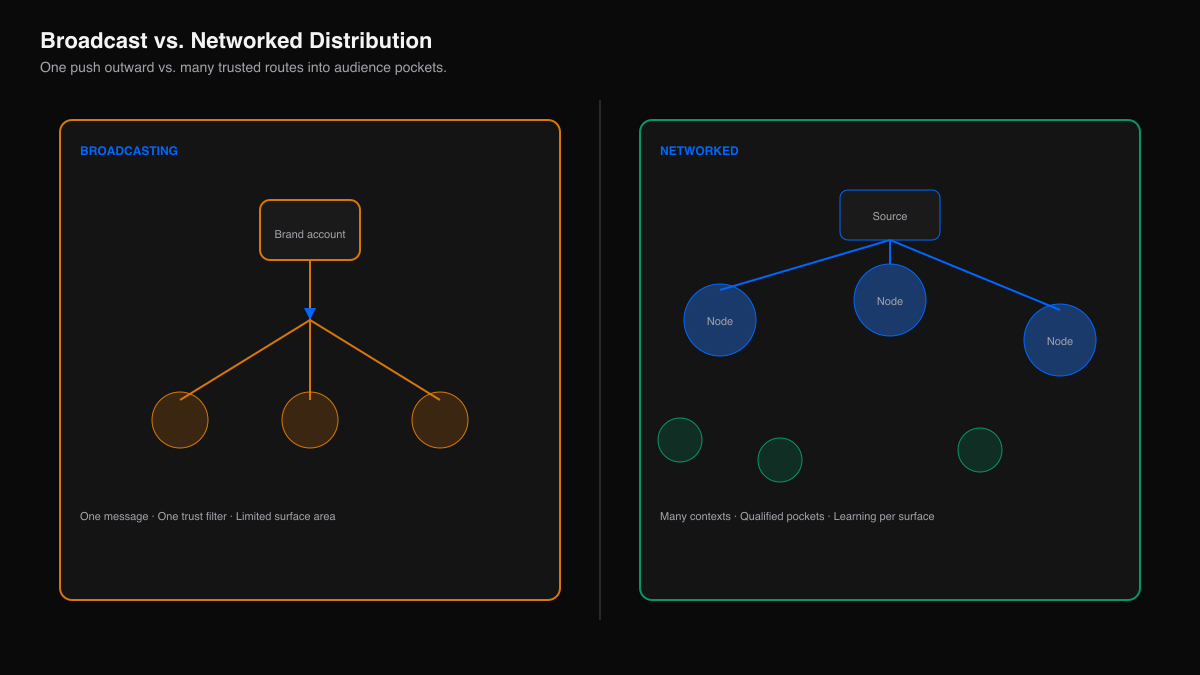
Broadcasting is a one-to-many model. A company creates a message, chooses a channel, and pushes that message outward from a central account.
Networked distribution is a many-to-many model. A source message is broken into multiple units, adapted by multiple creators, routed through multiple surfaces, tested across multiple audience pockets, and fed back into an optimization loop.
The operational difference is large.
| Dimension | Broadcasting | Networked Distribution |
|---|---|---|
| Primary unit | Brand message | Creator-mediated distribution event |
| Channel logic | Central account publishes outward | Many creator nodes route into audience contexts |
| Trust source | Brand authority | Creator context plus source proof |
| Creative variation | Limited by internal team | Expanded by creator interpretation |
| Feedback speed | Slow, aggregated reporting | Distributed, variant-level learning |
| Risk profile | Platform dependency and audience fatigue | Governance complexity and network integrity risk |
| Scaling constraint | Budget, central team output, platform reach | Creator density, incentives, workflow, quality control |
Broadcasting does not disappear. Brand accounts still matter. Paid media still matters. Owned audience still matters. But broadcasting becomes one layer in a larger system.
The old distribution question was:
How do we get our message in front of more people?
The better networked distribution question is:
Which creator nodes can credibly translate this source material into the right audience contexts, and how do we coordinate them without losing quality, trust, or measurement?
This shift changes the role of the operator. The operator is no longer only a media buyer, social manager, editor, or influencer manager. The operator becomes a network architect.
A network architect manages five things:
- Node supply: enough qualified creators exist for the target audience and platform mix.
- Node quality: creators can produce useful, brand-safe, platform-native distribution events.
- Node activation: creators accept incentives, understand the brief, and publish reliably.
- Node governance: claims, rights, brand standards, compliance, and fraud are controlled.
- Node learning: performance data improves future creator selection, briefing, incentives, and reallocation.
A creator network becomes a channel when those five elements are repeatable.
Creator Node Types
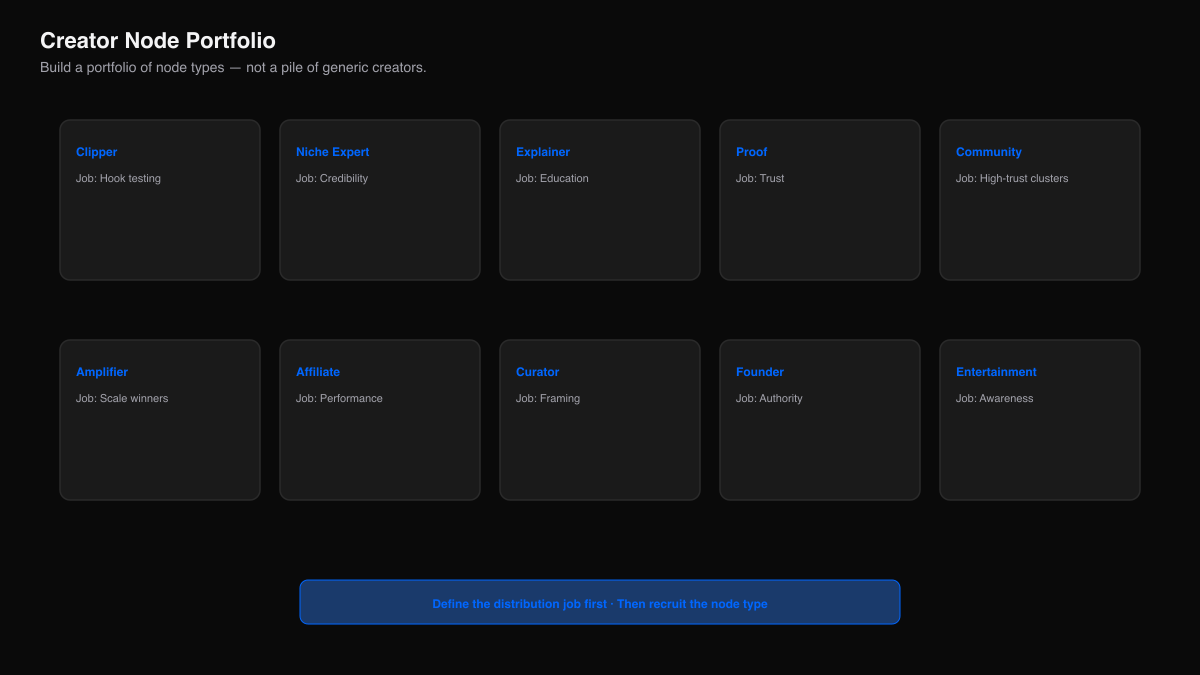
A mature creator network is not a pile of interchangeable creators. It is a portfolio of node types.
Different nodes create different kinds of distribution value.
| Node Type | Primary Value | Typical Use |
|---|---|---|
| Clipper Node | Identifies and packages high-potential moments from source content. | Short-form distribution, rapid angle testing, source-content multiplication. |
| Niche Expert Node | Brings category credibility and interpretation. | Technical audiences, professional trust, high-consideration categories. |
| Entertainment Node | Converts the message into culturally native formats. | Broad awareness, memetic reach, trend adaptation. |
| Explainer Node | Makes a complex idea understandable. | Education, onboarding, product understanding, market creation. |
| Proof Node | Adds credibility through review, testimonial, reaction, or use-case validation. | Trust building, conversion support, objection handling. |
| Community Node | Routes content inside private or semi-private audience clusters. | Forums, Discords, Slack groups, newsletter communities, professional circles. |
| Curator Node | Selects, frames, and recommends useful material. | Thought leadership, resource distribution, expert discovery. |
| Amplifier Node | Extends reach around already-proven assets. | Scaling winners, recycling high-performing hooks, event momentum. |
| Founder or Employee Node | Carries institutional trust and direct category POV. | Authority building, recruiting, investor narrative, customer trust. |
| Affiliate or Ambassador Node | Combines distribution with measurable conversion incentive. | Performance campaigns, offers, trials, signups, referrals. |
A campaign may not need every node type. But the operator should know which node type the system is using and what job that node type is supposed to perform.
Creator mismatch is one of the most common reasons campaigns fail.
A proof-heavy product may be given to entertainment nodes who can drive views but not trust. A technical category may be assigned to generic lifestyle creators who cannot interpret the value proposition. A founder-led category narrative may be handed to clippers without enough source context. A conversion-oriented campaign may activate awareness nodes and then complain about weak downstream outcomes.
The node type must match the distribution job.
The practical rule:
Do not recruit creators first. Define the distribution job first, then recruit the node type that can perform it.
Creator Density: The Supply-Side Constraint
Creator Density is the concentration of relevant, reachable, incentivizable creator network nodes inside a target audience, category, platform, or narrative territory.
It answers:
How many qualified creators can credibly reach the audience we care about, and how tightly are those creators clustered around the same demand surface?
Creator Density is not the same as creator abundance.
A market may have many creators and still have low Creator Density for a specific campaign. For example, there may be thousands of finance creators, but only a small number who can credibly explain a niche B2B fintech product to CFOs. There may be millions of lifestyle creators, but few who can reach high-intent buyers without making the campaign feel generic. There may be many clippers, but few with the speed, taste, rights discipline, and platform knowledge required for a given source-content strategy.
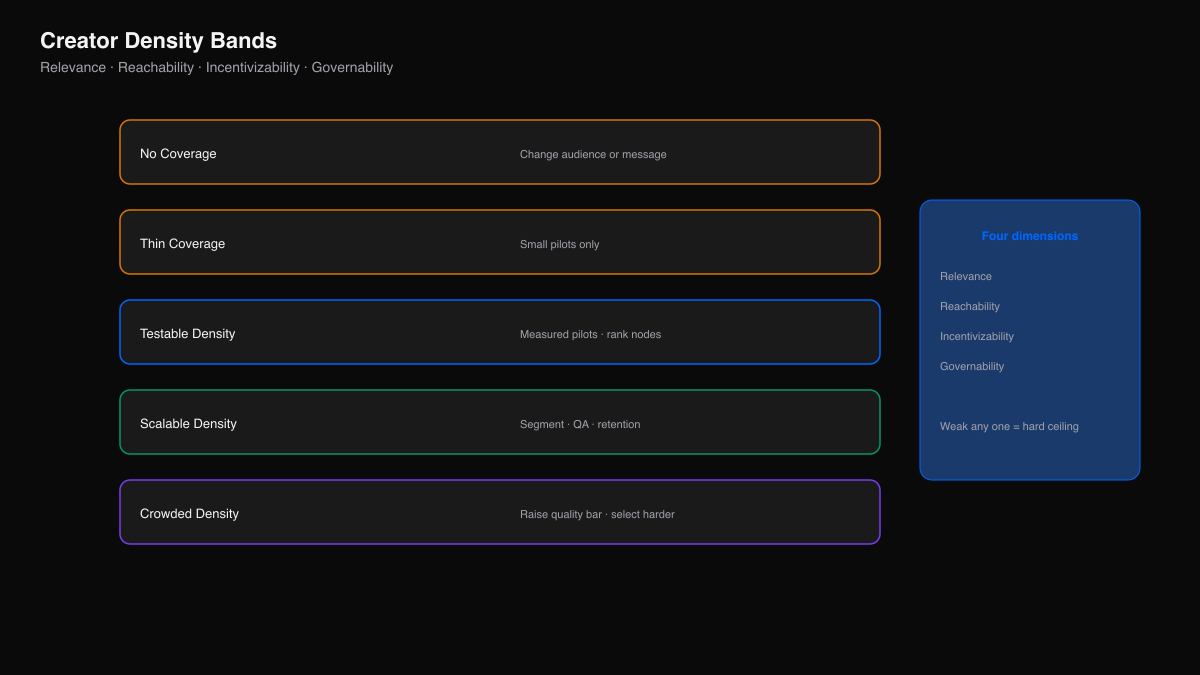
Creator Density has four components:
- Relevance: the creator’s audience matches the target audience.
- Reachability: the creator can be contacted, recruited, briefed, and activated.
- Incentivizability: the creator will participate under a feasible economic or status model.
- Governability: the creator can operate within brand, claims, rights, disclosure, and quality rules.
A creator who is relevant but unreachable does not increase operational density.
A creator who is reachable but not trusted does not increase qualified density.
A creator who is trusted but unwilling to participate under the incentive model does not increase usable density.
A creator who can drive views but violates claims or brand-safety rules can reduce effective density because the system must spend time repairing damage.
The density equation is directional:
Creator Density = (Reachable Nodes x Average Fit x Average Reliability x Activation Probability) / Audience Fragmentation
This is not a universal mathematical law. It is an operating model. The point is to prevent teams from counting raw creator supply as usable distribution capacity.
Density Bands
| Density Band | Meaning | Operator Action |
|---|---|---|
| No Coverage | No qualified creator nodes exist or can be reached for the audience/surface. | Change the audience, change the message, build supply, or use another channel. |
| Thin Coverage | A few qualified nodes exist, but activation is fragile. | Run a small pilot, improve incentives, recruit adjacent nodes, avoid scale claims. |
| Testable Density | Enough nodes exist for controlled experimentation. | Launch a measured pilot, compare node types, build a ranked roster. |
| Scalable Density | Enough qualified nodes exist across several audience pockets. | Segment cohorts, tighten QA, reallocate toward winners, build retention loops. |
| Crowded Density | Many creators exist, but differentiation and trust are compressed. | Use stronger proof, narrower briefs, higher quality bars, and more precise selection. |
The most important phrase is qualified creator nodes.
A creator database with 10,000 names may produce thin density if most creators are low fit, inactive, unreachable, expensive, noncompliant, or audience-misaligned. A smaller network with 200 high-fit creators across the right pockets may produce scalable density.
Vetting: Quality Starts Before Activation
Most creator network problems are created before the campaign starts.
If the vetting system admits the wrong creators, the rest of the infrastructure becomes defensive. The team spends its energy rejecting content, correcting claims, policing behavior, chasing submissions, and explaining why performance was weak.
Good vetting prevents downstream drag.
Creator vetting should evaluate at least eight attributes:
- Audience relevance: who the creator reaches and whether that audience matches the campaign.
- Platform fluency: whether the creator understands the native format, pacing, language, and norms of the surface.
- Category comprehension: whether the creator can understand the source material well enough to avoid distortion.
- Trust profile: whether the creator has a credible relationship with the audience for this topic.
- Content quality: whether the creator can produce work above the campaign’s quality threshold.
- Reliability: whether the creator submits on time and responds to operational instructions.
- Integrity risk: whether the creator shows signs of fraud, low-quality traffic, plagiarism, policy risk, or undisclosed conflicts.
- Incentive fit: whether the creator is likely to act rationally under the proposed compensation model.
Vetting should not be based only on social metrics.
A creator with high average views may still be a poor fit if the audience is wrong. A creator with polished production may be too generic for a high-trust niche. A creator with strong taste may be unusable if they ignore deadlines. A creator with a large following may be risky if their engagement quality is suspect.
The most useful vetting artifact is a Creator Vetting Scorecard.
The scorecard should create a structured record for each creator:
- Creator name / handle
- Platform(s)
- Audience category
- Estimated audience fit
- Node type
- Content examples reviewed
- Quality notes
- Brand-safety notes
- Compliance considerations
- Historical performance if available
- Recommended campaign role
- Approved, pilot, reject, or hold decision
- Reviewer and date
The vetting record gives the network a memory.
Without a vetting record, the network cannot learn. The team repeats the same decisions, re-reviews the same creators, forgets why a node underperformed, and cannot distinguish between bad creator selection and bad content.
Briefing Without Killing Authenticity
A creator-powered system has a control paradox.
Too little control creates inaccurate claims, brand risk, low-quality posts, duplicated creative, fraud, and audience mismatch.
Too much control destroys the reason creators are valuable: context, fluency, voice, and trust.
The solution is not to script every creator. The solution is to separate non-negotiables from creative variables.
Non-Negotiables
Non-negotiables should include:
- Approved claims
- Prohibited claims
- Required disclosures
- Rights and usage limitations
- Brand-safety boundaries
- Offer details
- Required links or tracking rules
- Platform-specific compliance rules
- Deadline and submission rules
- Payment qualification rules
Creative Variables
Creative variables should include:
- Hook selection
- Format
- Story structure
- Tone
- First-person interpretation
- Example selection
- Visual style
- Editing style
- Cultural references
- CTA phrasing within approved boundaries
This is the briefing rule:
Control the facts, not the voice.
The creator should know what must be true. The creator should not be forced to sound like the brand account.
A useful creator brief includes:
- Campaign objective
- Audience definition
- Source content summary
- Core thesis
- Approved proof points
- Hook menu
- Angle menu
- Claims library
- Prohibited claims
- Required disclosures
- Creative examples
- Submission requirements
- Tracking and payout rules
- Revision process
The brief is not a script. It is a safe operating surface.
Incentive Design: Paying for the Behavior You Actually Want
Incentives shape the network.
A creator-powered distribution system cannot rely on motivation alone. Creators respond to economic rewards, status rewards, learning rewards, access rewards, speed of payment, fairness, and perceived upside.
Bad incentives create bad behavior.
If the system pays only for raw views, creators may chase low-quality traffic, misleading hooks, or broad audiences with weak relevance. If the system pays only flat fees, creators may minimize effort after payment is secured. If the system pays only after high conversion thresholds, creators may avoid participating because the risk is too high. If payment rules are unclear, strong creators may leave even if the opportunity is good.
A good incentive model aligns four interests:
- The brand wants qualified attention, trust, learning, and business outcomes.
- The creator wants fair compensation, clarity, upside, and respect.
- The audience wants useful, relevant, non-deceptive content.
- The platform rewards engagement, format fit, retention, and policy compliance.
Common incentive models include:
| Incentive Model | Strength | Risk |
|---|---|---|
| Flat Fee | Predictable, easy to recruit higher-trust creators. | Weak performance alignment if not paired with standards. |
| Pay Per Qualified View | Aligns with attention output. | Requires clean tracking and fraud controls. |
| Tiered Performance Bonus | Rewards winners without making all compensation uncertain. | Requires clear thresholds and timely reporting. |
| Bounty / CPA | Aligns with downstream action. | Can underpay top-of-funnel value and discourage creators. |
| Retainer | Supports durable creator relationships. | Can become inefficient without output expectations. |
| Hybrid Fee + Performance | Balances creator security with upside. | More complex to manage. |
| Access / Status Incentives | Useful for communities, launches, and category insiders. | Not enough for many creators unless paired with economic value. |
The right model depends on the campaign objective.
Awareness campaigns should not be judged only by direct conversion. Conversion campaigns should not ignore attention quality. Category-creation campaigns need learning value, not just immediate purchase action. Launch campaigns may reward speed and volume. Evergreen distribution may reward retention and reliable output.
The key is to define the payable behavior before activation.
A creator should know:
- What earns payment?
- What earns bonus payment?
- What disqualifies a submission?
- What counts as fraud or invalid traffic?
- How are views or outcomes verified?
- When will payments occur?
- How are disputes resolved?
Ambiguity is expensive. It creates support burden, creator distrust, and retention problems.
The night the incentive system told the truth
I understood this intellectually before I understood it operationally.
During a June 2026 quality review, I went through campaign submissions by hand because a client believed the work looked manipulated and low quality. The client was right. Contributors had learned how to win the payout rules without producing work a serious brand would want to stand behind.
The next day's budget audit made the failure impossible to rationalize. Roughly 90% of campaign budget had been flowing toward weak accounts. About $5,000 was associated with accounts that had already disappeared or been suspended. Meanwhile, several capable clippers had submitted five or ten strong clips, earned nothing, and stopped participating.
The network was not randomly becoming worse. We were paying it to become worse.
I stayed up until six or seven in the morning contacting strong accounts one at a time. We clawed back the available campaign budget, restricted the relaunch to higher-trust contributors, increased the incentive, upgraded proven accounts, and apologized to people whose first experience with us had punished quality.
That intervention produced one of the most important rules in this book:
An incentive system is a selection system.
Every payout teaches the network what survives. If weak work earns quickly while strong work waits, the strongest contributors leave first. If suspended accounts keep consuming budget, honest contributors conclude that the market is not real. If the only score is raw views, the system attracts people best at manufacturing raw views.
Creator supply is not the number of names in a database. It is the amount of trusted capacity the system can activate without lowering the standard.
Quality Control: Governance Without Bottlenecking the Network
Creator networks require quality control, but quality control can become the bottleneck that kills velocity.
The operator needs a tiered governance system.
Not every asset needs the same review path. Not every creator deserves the same level of freedom. Not every category has the same compliance burden. Not every campaign has the same brand risk.
A practical quality-control system has four levels:
Level 1: Pre-Approved Asset Use
Creators use approved clips, captions, claims, links, and visual assets. This is the safest and fastest mode. It works well for early pilots, regulated claims, or creators who are not yet trusted.
Level 2: Creator Adaptation With Pre-Publish Review
Creators adapt hooks, edits, captions, or framing but submit for approval before publishing. This balances authenticity with control. It is useful for campaign expansion.
Level 3: Trusted Creator Autonomy
High-quality creators with strong track records can publish within approved boundaries without every asset receiving pre-publish review. This improves velocity and retains top creators.
Level 4: Strategic Creator Collaboration
Core creators help shape source content, identify new angles, surface audience objections, and influence campaign strategy. This is not just distribution; it is market intelligence.
The mistake is using one review path for every creator.
If all creators are treated as untrusted, the network slows down and top creators churn. If all creators are treated as trusted, governance risk rises. The system should earn autonomy through performance and compliance history.
Quality control should measure:
- Approval rate
- Rejection reasons
- Revision cycles
- Time to approve
- Claim violation rate
- Brand-safety incident rate
- Creator-level compliance history
- Asset-level performance after approval
The purpose is to improve the system, not merely police creators.
If many creators fail for the same reason, the problem may be the brief, source material, claims library, or onboarding process.
Fraud and Network Integrity
Creator-powered distribution creates new trust surfaces. It also creates new attack surfaces.
A system that pays creators for distribution events must expect integrity risk. Fraud does not have to be dramatic to be damaging. Low-quality traffic, recycled content, misleading claims, unverifiable views, fake engagement, duplicate submissions, rights violations, and misattribution can quietly erode the economics of the channel.
A creator network needs an integrity layer.
Common integrity risks include:
| Risk | Description | Control |
|---|---|---|
| Fake or Low-Quality Views | Views generated by bots, engagement pods, low-intent traffic, or suspicious sources. | Platform analytics review, anomaly detection, retention checks, qualified-view definitions. |
| Duplicate Submissions | Same or near-identical asset submitted by multiple creators. | Asset fingerprinting, source tags, duplicate review, submission windows. |
| Recycled Content | Creator reuses unrelated or old content to claim payment. | Source matching, metadata review, manual QA for sampled posts. |
| Misleading Hooks | Creator exaggerates or distorts claims to drive attention. | Claims library, prohibited-claim list, escalation rules. |
| Undisclosed Sponsorship | Creator fails to disclose required commercial relationship. | Disclosure requirements, review checklist, creator education. |
| Rights Violations | Creator uses music, footage, logos, testimonials, or likenesses without permission. | Approved asset library, rights metadata, takedown process. |
| Misattribution | Performance is credited to the wrong creator, asset, or campaign. | Tracking links, creator IDs, asset IDs, submission logs. |
| Impersonation | Fake creator accounts or unauthorized publishers enter the network. | Identity verification, payment verification, handle validation. |
Integrity controls should be proportional.
Overly aggressive controls can slow the system and frustrate good creators. Weak controls can destroy trust and economics. The correct level depends on payout size, category risk, campaign scale, and the maturity of the network.
The minimum integrity layer should include:
- Creator identity and handle verification
- Payment account verification
- Asset and submission logs
- Required disclosure rules
- Approved claims and prohibited claims
- Qualified-view definition
- Suspicious performance review
- Dispute and appeal process
- Repeat-offender policy
- Incident log
The incident log is important. A system that does not record integrity issues cannot improve.
Compliance and Brand Safety
Compliance is not optional infrastructure.
The more decentralized the distribution system becomes, the more important governance becomes. A central brand account can be reviewed by a small internal team. A creator network can produce many posts across many platforms by many people with different levels of knowledge, urgency, and judgment.
This does not mean creator-powered distribution is too risky. It means the operating system must be designed for risk.
Brand and compliance rules should be written in language creators can use.
Bad compliance guidance sounds like legal policy. Good compliance guidance turns risk into operational rules.
Instead of only saying:
Avoid misleading claims.
The brief should say:
- Do not promise guaranteed income.
- Do not claim the product works for every user.
- Do not cite customer results unless using an approved case example.
- Do not imply affiliation with a platform unless approved.
- Do not use before/after numbers unless sourced from the approved proof library.
- Do not omit required disclosure language.
Creator networks need a claims library.
A claims library should include:
- Approved claims
- Approved proof points
- Claims requiring exact wording
- Claims requiring disclosure
- Claims requiring source citation
- Prohibited claims
- Category-specific compliance notes
- Examples of acceptable phrasing
- Examples of unacceptable phrasing
Compliance should also be attached to asset metadata. If a clip contains a claim that is only approved for certain audiences, platforms, territories, or time windows, the distribution system should know that before creators publish it.
Governance is not anti-creator. Good governance protects creators from accidental risk and protects the network from avoidable failure.
Retention: The Difference Between Campaign Labor and Creator Capital
Creator retention is the difference between episodic campaign labor and durable Creator Capital.
If every campaign requires rebuilding the creator base from scratch, the system is not compounding. It may still work, but it remains expensive, slow, and fragile.
A retained creator is more valuable than a newly recruited creator when they have:
- Proven category fit
- Known quality level
- Known reliability
- Known compliance behavior
- Known performance history
- Familiarity with the brand and source material
- Trust in the payment and review process
- Ability to move faster in future campaigns
Retention does not mean keeping every creator.
A healthy network should graduate some creators into core roles, keep some creators in a test cohort, and remove creators who create risk or drag. Retention should be selective.
The retention loop is:
- Identify strong creators.
- Pay quickly and accurately.
- Give useful feedback.
- Share performance learning.
- Offer clearer future opportunities.
- Increase autonomy for trusted creators.
- Invite creators into better-fitting campaigns.
- Track performance across time.
The most overlooked retention lever is operational fairness.
Creators remember whether the brief was clear, whether feedback was arbitrary, whether payment was timely, whether the rules changed mid-campaign, and whether the brand respected their voice.
Creator trust is infrastructure.
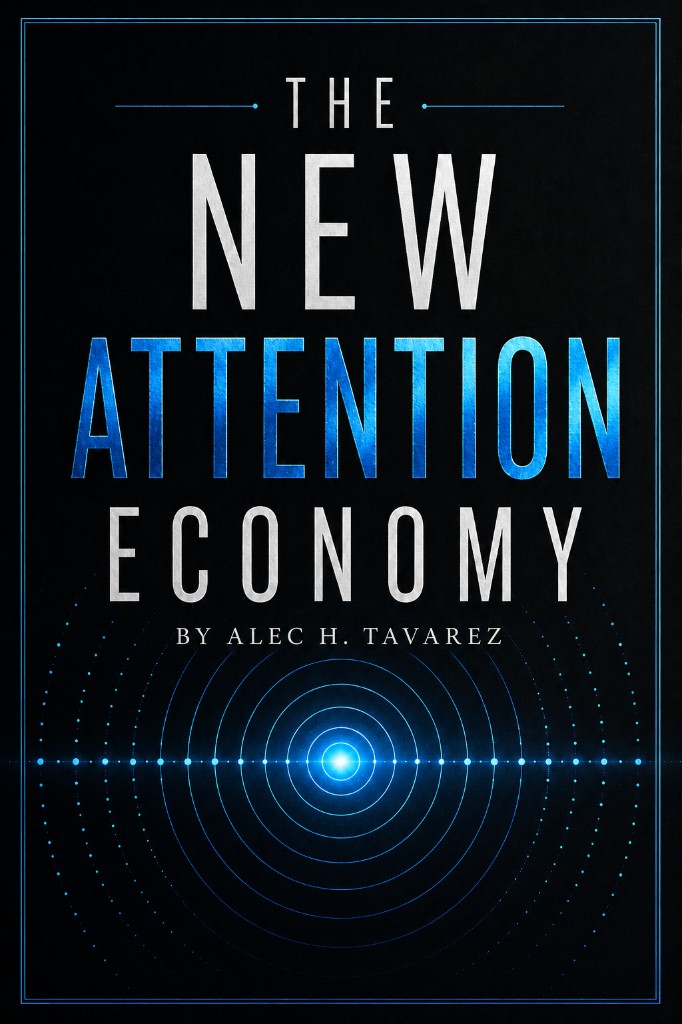
Read the whole book
The New Attention Economy: The Distribution Manifesto, 11 chapters, free to read and share.
Related courses
When you are ready to apply it
Ready to launch a campaign?
Use Clipur to turn existing content into distributed short-form reach.