
The Distribution Manifesto
Chapter 3 of 11 · 19 min read
The Distribution Readiness Score
What Must Exist Before You Scale
The argument
The Distribution Infrastructure Layer is the operating system that turns creator-powered distribution from a set of tactics into a repeatable business capability.
A company does not have distribution infrastructure because it posts clips, hires creators, sponsors influencers, or runs paid ads with creator-style creative. It has distribution infrastructure when content, creators, incentives, workflow, data, governance, and capital allocation are coordinated into one system that can learn and improve.
This chapter defines that layer in operational terms. It also introduces the Distribution Readiness Score, the first practical diagnostic in this book.
From Paradigm to Operating Layer
Chapter 1 defined the problem: dependable access to relevant attention is harder to engineer through legacy distribution alone.
Chapter 2 defined the category response: Creator-Powered Distribution.
Chapter 3 defines the operating layer required to make that category real.
This distinction matters because most teams confuse distribution activity with distribution infrastructure.
They run campaigns. They post content. They buy media. They pay creators. They test platforms. They sponsor podcasts. They brief clippers. They repurpose long-form videos. They publish from founder accounts. They hire agencies. They launch affiliate programs.
Those activities can produce results. They do not automatically produce infrastructure.
Infrastructure exists when the system becomes repeatable. A campaign becomes infrastructure when the team can brief creators faster, identify better hooks, route assets to better surfaces, improve quality control, measure qualified attention, reallocate budget, and preserve learning for the next cycle.
The strategic difference is large.
Without infrastructure, distribution output is episodic. With infrastructure, distribution output becomes cumulative.
Without infrastructure, a strong clip is a lucky asset. With infrastructure, a strong clip is a signal.
Without infrastructure, a creator who performs well is an anecdote. With infrastructure, that creator becomes a ranked node inside a growing creator-capital base.
Without infrastructure, a campaign recap is a slide deck. With infrastructure, it is a system update.
The Tactical Trap
The tactical trap is the belief that a new mechanism will solve a structural distribution problem.
The team sees weak growth and asks for more output. The brand account is stagnant, so they ask for more posts. Paid acquisition becomes expensive, so they ask for more creator ads. The founder podcast is underused, so they ask for more clips. The short-form account is inconsistent, so they hire another editor. Influencer posts underperform, so they try a different influencer. Affiliate content is low quality, so they change the commission.
The surface-level diagnosis is often wrong.
The problem is not always the mechanism. The problem is often that the mechanism is operating without infrastructure.
A clipping campaign without a source-content pipeline becomes a scramble. A creator network without incentives becomes a directory. An influencer program without measurement becomes a PR expense. A paid amplification program without creative learning becomes budget burn. A content calendar without distribution surfaces becomes internal publishing theater.
The tactical trap is expensive because each tactic appears to fail independently. The company then rotates through vendors, platforms, formats, and agencies without fixing the underlying system.
The better question is not: “Which tactic should we try next?”
The better question is: “Which layer of our distribution infrastructure is missing, weak, or unmeasured?”
The MVP with green checkmarks
The first time I saw the difference between software and infrastructure, it was written in my own product document.
Our March 2026 MVP checklist had a satisfying group of green checks. Three user roles worked: clipper, brand, and admin. A brand could create a raw campaign. An admin could approve it and make it live. A clipper could submit work. An admin and then the brand could approve clips.
It looked close to finished until you read the notes beside the checks.
Clip submission was “functional” but still needed automation. Admin approval worked, but we were already questioning whether the step belonged there. Brand approval worked, but the document said it had “no safeguard.”
That phrase mattered more than every green check above it.
The product could move a campaign object from one state to another. It could not yet guarantee that the brief was complete, the budget was protected, the clip was legitimate, the approval was informed, the payout was accurate, or the client knew what happened next.
The next-version wish list went in the opposite direction: replace nearly every text box with one AI intake, automatically generate the proposal and timeline, and launch with no human intervention. I wanted to erase the 12- to 16-hour days that had created the product.
The temptation was to automate the pain before we had fully understood the judgment inside it.
In a product meeting, I argued that we needed roughly six months of manually reviewed campaign data before turning more approval decisions over to AI. I did not always hold that line perfectly, but the principle survived:
A feature is enabled when the software can perform it. A capability is ready when the business can trust the outcome.
If you are evaluating a distribution product, do not stop at the demo. Ask what happens when the source link is wrong, the views keep growing after approval, the creator disputes a payout, the brand rejects work, the platform API fails, or the campaign reaches its budget cap early.
The answers reveal whether you are buying a tool, a service, or actual infrastructure.
Canonical Definition
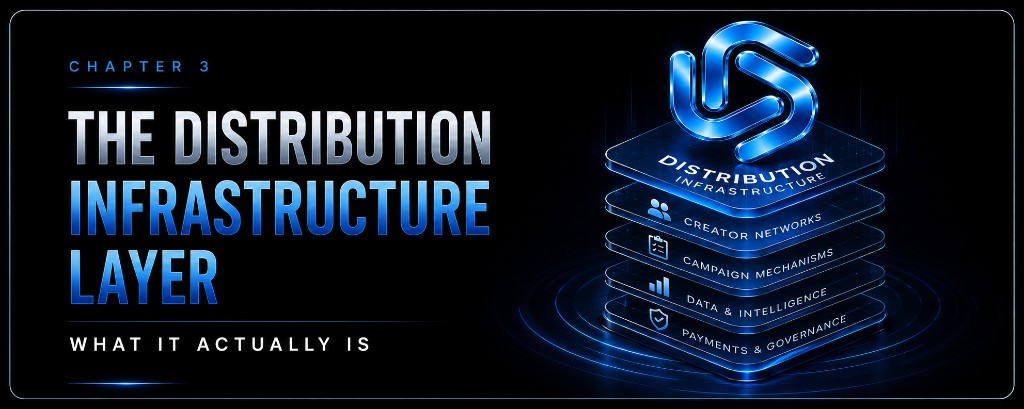
The Distribution Infrastructure Layer is the operational system that coordinates content, creators, incentives, data, automation, capital allocation, governance, and measurement to produce repeatable distribution outcomes.
It sits above individual mechanisms and below business strategy.
Business strategy defines what the company wants to make true in the market: which audience matters, what belief needs to change, what offer must be understood, which proof should travel, and which outcome the company wants to create.
Mechanisms create individual outputs: clips, posts, sponsorships, ads, newsletters, threads, community shares, ambassador videos, creator reactions, and syndication placements.
The Distribution Infrastructure Layer connects those two levels. It translates strategy into repeatable distribution behavior.
Simple model:
Business Strategy -> Distribution Infrastructure Layer -> Mechanisms -> Distribution Surfaces -> Performance Data -> System Improvement
A distribution mechanism can exist without infrastructure.
Infrastructure cannot exist without mechanisms.
The distinction is that mechanisms produce instances. Infrastructure produces capacity.
Where the Layer Sits
Distribution infrastructure is not the whole business. It is one layer of the business stack.
| Layer | Core Question | Typical Artifacts |
|---|---|---|
| Business Strategy | What market outcome are we trying to create? | ICP, offer, positioning, narrative, proof architecture, revenue goal |
| Content Source Layer | What raw material can carry the message? | Podcasts, founder videos, customer stories, webinars, livestreams, research, demos, internal expertise |
| Distribution Infrastructure Layer | How do we coordinate content, creators, incentives, workflow, measurement, governance, and capital? | Briefs, creator roster, incentive model, submission flow, QA rules, dashboards, reallocation cadence |
| Mechanism Layer | What specific outputs will be created and published? | Clips, reactions, creator posts, founder posts, ads, UGC, affiliate videos, newsletters, community drops |
| Distribution Surface Layer | Where will audiences encounter the content? | TikTok, YouTube Shorts, Instagram Reels, LinkedIn, X, niche accounts, Discords, newsletters, search, communities |
| Feedback Layer | What did the system learn? | Hook performance, creator scores, qualified views, watch time, comments, conversion proxies, rejection reasons |
This stack prevents category confusion.
Creator-Powered Distribution is not just the mechanism layer. It is the coordinated use of creator-powered mechanisms through the infrastructure layer.
Clipper University should teach the stack. Clipur should help operationalize the stack.
That positioning is important. If Clipur is perceived only as a clipping vendor, the category collapses into a service line. If Clipur is positioned as infrastructure, clipping becomes the wedge, not the ceiling.
The Eight Components of the Distribution Infrastructure Layer
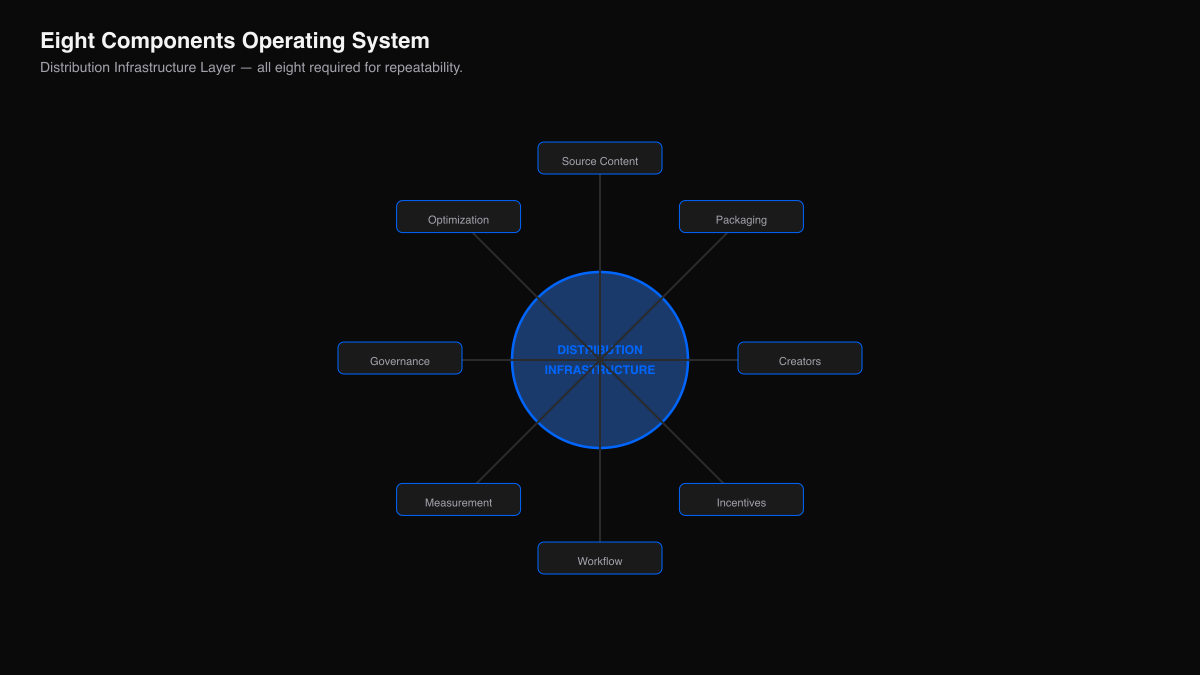
The Distribution Infrastructure Layer has eight core components.
Each component has a different job. Mature systems make the components explicit. Immature systems let them remain implicit, scattered, or dependent on individual operators.
1. Content Source Layer
The content source layer supplies the raw material for distribution.
Creator-powered distribution does not start with clips. It starts with source material that can be packaged into credible, context-specific assets.
Source content can include:
- Founder-led video
- Podcasts
- Webinars
- Livestreams
- Customer calls
- Case-study interviews
- Product demos
- Event footage
- Internal trainings
- Research reports
- Community discussions
- Sales objections
- Support insights
- Long-form essays
- Recorded workshops
The key question is not whether the company has “content.” The key question is whether the company has content with distribution potential.
Distribution-ready source content usually has at least one of the following properties:
- Clear point of view
- Specific audience relevance
- Demonstrable expertise
- Narrative tension
- Practical utility
- Social proof
- Contrarian insight
- Emotional resonance
- Strong visual or verbal moments
- Search or platform-native demand
Operator questions:
- What source content exists today?
- Which assets contain the clearest proof?
- Which assets contain the strongest founder, customer, or expert point of view?
- Which assets can be cut into multiple formats without losing context?
- Which claims require compliance, legal, or brand review before distribution?
Common failure mode: source-content starvation.
A team recruits creators or hires editors before it has enough raw material worth distributing. The system then turns into forced production. Creators receive weak source material. Editors manufacture hooks without substance. Approval teams reject outputs because the source was never designed to travel.
Correction: build a source-content inventory before scaling distribution. Treat source content as supply, not as a creative afterthought.
2. Packaging Layer
The packaging layer converts source content into platform-native assets.
Packaging includes:
- Clip selection
- Hook writing
- Captioning
- Editing
- Framing
- Thumbnail selection
- Intro sequencing
- Pattern interrupts
- Context-setting
- Platform-specific formatting
- Creator commentary
- Remixing
- Call-to-action design
Packaging is where many distribution systems win or fail.
A strong idea can die from weak packaging. A mediocre idea can temporarily outperform because it is packaged in a format that the feed understands. This does not mean packaging is more important than substance. It means distribution systems must respect the difference between message quality and feed compatibility.
Operator questions:
- Which source moments deserve distribution?
- Which hooks map to which audience segments?
- Which platforms require different intros or context?
- Which formats preserve credibility and which create clickbait risk?
- Which packaging patterns should become reusable templates?
Common failure mode: asset production without variant testing.
The team cuts clips, publishes them, and reports aggregate views. It does not isolate which hook, edit, creator, surface, or topic drove the result.
Correction: package content as a portfolio of tests. Each asset should create learning, not just output.
3. Creator Layer
The creator layer contains the people and accounts that package, interpret, publish, route, or amplify content.
In Creator-Powered Distribution, creators are not merely rented audiences. They are distribution nodes.
A Creator Network Node can be:
- A clipper
- A short-form editor
- A niche account operator
- A founder evangelist
- A customer advocate
- An affiliate creator
- A community operator
- A subject-matter expert
- A meme page
- A micro-influencer
- A newsletter curator
- A platform-native commentator
The value of the creator layer comes from fit, context, reliability, quality, and learning density. Follower count alone is a weak proxy.
Creator Capital is the accumulated distribution capacity created by a trusted, measurable, and repeatable base of creator nodes.
A company with creator capital can launch faster, test more formats, access more surfaces, and compound learning across campaigns.
A company without creator capital has to reacquire distribution labor every time it wants to move content.
Operator questions:
- Which creator archetypes match the audience?
- Which creators understand the category?
- Which creators can package content without distorting the message?
- Which creators are reliable under deadline?
- Which creators produce qualified attention, not just volume?
- Which creators should receive more budget, access, or briefs?
Common failure mode: creator mismatch.
The team selects creators based on size, availability, or surface-level niche alignment. The creators can generate views but cannot create trust, qualified attention, or message accuracy.
Correction: define creator archetypes before recruitment. Score creators on audience fit, content fit, trust context, output quality, reliability, compliance history, and performance data.
4. Incentive Layer
The incentive layer determines what behavior the system rewards.
Incentives shape output quality, speed, volume, risk, and retention. Poor incentives create poor distribution behavior even when creators are talented.
Incentive models can include:
- Fixed fees
- Clip bounties
- View-based payouts
- Qualified-view payouts
- Performance bonuses
- Contests
- Revenue share
- Affiliate commissions
- Tiered access
- Exclusive briefs
- Status and recognition
- Long-term creator tracks
The right incentive model depends on the campaign objective and the risk profile.
If the system rewards raw views only, creators may optimize for sensational packaging, weak relevance, or misleading hooks. If the system rewards approvals only, creators may become conservative and reduce experimentation. If the system rewards conversions only, creators may avoid upper-funnel educational content that produces long-term demand but weak immediate attribution.
The incentive layer should align with the desired behavior.
Operator questions:
- What should creators optimize for?
- What behavior should the system avoid?
- Are creators rewarded for quality, speed, compliance, performance, or all four?
- What metrics are too easy to game?
- How does the incentive model change by creator tier?
- How will the team prevent fraud, duplicate submissions, and low-quality volume?
Common failure mode: incentive mismatch.
The team says it wants qualified attention but pays only for raw output. The team says it wants speed but creates a slow approval process. The team says it wants brand safety but rewards creators who take the biggest creative risks.
Correction: make the incentive model explicit. Tie payout logic to the behaviors the system actually needs.
5. Workflow Layer
The workflow layer controls how work moves through the system.
It includes:
- Campaign setup
- Source asset intake
- Brief creation
- Creator onboarding
- Rights and permissions
- Submission intake
- Review and approval
- Revision requests
- Publishing rules
- Tracking setup
- Payout operations
- Communication
- Escalation paths
- Reporting cadence
Workflow is often the hidden bottleneck in creator-powered distribution.
A team can have strong source content, good creators, and clear incentives, but still fail because the operating workflow cannot absorb volume.
The signs are predictable: approvals lag, creators wait for answers, assets sit in folders, tracking links are missing, legal review arrives late, payouts become manual, and campaign managers become the system.
When people are the infrastructure, scale breaks them.
Operator questions:
- Who owns each stage of the campaign?
- What is the expected turnaround time for submissions?
- Which approvals are mandatory and which are optional?
- How are creators notified of revisions?
- Where does each asset live?
- What metadata is captured at submission?
- How are payouts calculated and verified?
Common failure mode: manual chaos.
The workflow exists across spreadsheets, DMs, email threads, folders, and individual memory. The team can run one campaign but cannot run ten without degradation.
Correction: define the operating cadence before adding volume. The minimum workflow should include source intake, brief distribution, submission capture, review status, publishing confirmation, tracking, payout status, and post-campaign learning.
6. Measurement Layer
The measurement layer determines what the system can learn.
Creator-powered distribution produces many signals. Not all signals are equally useful.
Common metrics include:
- Published assets
- Approved assets
- Rejected assets
- Creator activation rate
- Views
- Qualified views
- Watch time
- Retention
- Engagement
- Saves
- Shares
- Comments
- Clicks
- Conversion proxies
- Follower growth
- Search lift
- Brand search proxies
- Cost per approved asset
- Cost per published asset
- Creator-powered CPM
- Cost per qualified outcome
The measurement layer should connect performance to decision-making.
If a dashboard reports numbers but does not change creator selection, content selection, hook strategy, platform mix, payout allocation, or campaign design, it is reporting rather than measurement infrastructure.
Measurement infrastructure should answer four questions:
- What worked?
- Why did it likely work?
- Where should the system allocate more resources?
- What should be stopped, changed, or retested?
Operator questions:
- Can we track performance by creator?
- Can we track performance by source asset?
- Can we track performance by hook or topic?
- Can we separate raw attention from qualified attention?
- Can we identify performance by platform and surface?
- Can the data influence budget, creator access, or brief strategy?
Common failure mode: vanity measurement.
The team reports total views and top clips but cannot explain which audience was reached, which creators were valuable, which hooks transferred, or which assets should be reused.
Correction: design measurement around decisions. Every metric should map to an action.
7. Governance Layer
The governance layer protects quality, rights, compliance, brand safety, and strategic integrity.
Governance is not the enemy of scale. Governance is what makes scale survivable.
The governance layer can include:
- Rights and usage terms
- Approved claims
- Disallowed claims
- Brand voice boundaries
- Legal review triggers
- Compliance rules
- Disclosure requirements
- Visual identity rules
- Source-content permissions
- Creator conduct rules
- Fraud detection
- Duplicate-content controls
- Takedown procedures
- Escalation paths
Creator-powered distribution expands surface area. Expanded surface area increases the number of contexts in which the brand can be represented, misrepresented, clipped, remixed, praised, criticized, or misunderstood.
A distribution system without governance can scale risk faster than it scales trust.
Operator questions:
- What can creators claim?
- What can creators not claim?
- Which claims require substantiation?
- What rights does the brand have to creator outputs?
- What rights do creators have to source content?
- What triggers legal or compliance review?
- What happens when a creator violates rules?
- What content should be removed, revised, or blocked?
Common failure mode: ungoverned scale.
The system expands distribution before defining rules. Creators improvise claims. Editors overstate benefits. Clips remove necessary context. The brand becomes reactive.
Correction: create the governance layer before the campaign scales. Rules should be clear enough for creators to follow and strict enough for the brand to enforce.
8. Optimization and Capital Allocation Layer
The optimization layer converts performance data into better future distribution.
This is where infrastructure becomes compounding.
Optimization includes:
- Retiring weak hooks
- Promoting winning hooks
- Reallocating budget to stronger creators
- Giving top creators better source material
- Testing new surfaces
- Adjusting incentives
- Changing approval rules
- Building new packaging templates
- Improving briefs
- Segmenting creator cohorts
- Increasing investment where qualified attention is cheapest or highest quality
Capital allocation is not limited to money. It also includes access, source content, attention from internal operators, priority review, creative direction, and status within the network.
A creator-powered system should not treat all creators, assets, hooks, or surfaces equally after data exists.
Equal allocation is reasonable before learning. Equal allocation after learning is waste.
Operator questions:
- Which creators should get more opportunities?
- Which hooks should become templates?
- Which topics should be expanded into more source content?
- Which platforms should receive more testing?
- Which incentive changes would improve quality or speed?
- Which bottlenecks prevent winners from scaling?
Common failure mode: static allocation.
The team runs a campaign, sees the results, and then launches the next campaign with the same creator mix, same incentives, same brief structure, and same approval process.
Correction: create a reallocation cadence. The system should update after every campaign, and in mature systems, during campaigns.
The Distribution Readiness Score
The Distribution Readiness Score evaluates whether a brand, creator, media property, or organization has the assets, systems, incentives, and measurement capacity needed to run creator-powered distribution effectively.
It is not a branding exercise. It is an operating diagnostic.
The score exists because teams often launch distribution campaigns before their infrastructure can support them.
That causes false negatives.
A campaign may underperform not because Creator-Powered Distribution is wrong for the business, but because the company was not distribution-ready.
The Distribution Readiness Score prevents that mistake by separating market fit from infrastructure readiness.
Scoring Method
Score each dimension from 0 to 5.
| Score | Meaning |
|---|---|
| 0 | Missing or unusable |
| 1 | Present but fragile |
| 2 | Basic, inconsistent, or highly manual |
| 3 | Functional enough for a constrained pilot |
| 4 | Operationally reliable |
| 5 | Mature, repeatable, measurable, and scalable |
The maximum score is 40.
Dimension 1: Source Content Inventory
Does the company have enough raw material worth distributing?
A high score requires more than a few videos. It requires repeatable access to content with clear audience relevance, proof, expertise, story, or utility.
Examples of evidence:
- Library of long-form assets
- Founder or expert recordings
- Customer stories
- Product proof
- Category education
- Internal knowledge that can be externalized
- Content rights and permissions
Low score symptoms:
- Creators have nothing substantive to work from
- Editors are forced to manufacture hooks
- Every campaign starts with emergency content production
- Clips feel generic or contextless
Dimension 2: Message Clarity and Proof Architecture
Can creators understand and communicate the message without heavy supervision?
A high score requires clear positioning, claims, proof points, constraints, and audience-specific framing.
Examples of evidence:
- Positioning document
- Approved claim bank
- Disallowed claim list
- Customer proof
- Founder narrative
- Objection map
- Category POV
- Offer explanation
Low score symptoms:
- Creators misunderstand the product or audience
- Outputs are technically accurate but strategically weak
- Reviewers reject content for “not feeling right”
- Every asset requires heavy rewriting
Dimension 3: Creator Fit and Network Access
Does the company know which creator nodes should distribute the message, and can it reach them?
A high score requires specific creator archetypes, platform fit, audience fit, quality standards, and at least some access to the right network.
Examples of evidence:
- Creator archetype map
- Platform priority map
- Existing creator roster
- Vetting criteria
- Audience-fit requirements
- Creator quality history
Low score symptoms:
- Creators are selected mainly by follower count
- Creator recruitment is opportunistic
- Outputs reach the wrong audience
- Creators generate impressions but not qualified attention
Dimension 4: Incentive Design
Are creators rewarded in a way that drives the desired behavior?
A high score requires the incentive model to align with the campaign objective, quality requirements, speed requirements, and risk profile.
Examples of evidence:
- Payout logic
- Bonus criteria
- Quality gates
- Fraud controls
- Creator tiering
- Approval-linked rewards
- Qualified attention rules
Low score symptoms:
- Creators optimize for raw views when the brand wants qualified attention
- Creators submit low-quality volume
- Strong creators leave because upside is weak
- The system rewards behavior the brand later rejects
Dimension 5: Workflow and Operating Cadence
Can the team manage briefs, assets, submissions, reviews, publishing, tracking, and payouts without relying on heroics?
A high score requires clear ownership, status visibility, turnaround expectations, and repeatable operating routines.
Examples of evidence:
- Campaign launch checklist
- Asset intake process
- Brief template
- Submission portal or tracker
- Approval stages
- Revision workflow
- Publishing confirmation
- Payout workflow
- Weekly operating cadence
Low score symptoms:
- Work lives in DMs and spreadsheets
- Creators wait for approvals
- Submissions get lost
- Payouts require manual reconciliation
- Operators cannot tell campaign status quickly
Dimension 6: Measurement Quality
Can the system track performance at the creator, asset, hook, platform, surface, and outcome-proxy level?
A high score requires measurement that can change decisions, not just report totals.
Examples of evidence:
- Creator-level performance
- Asset-level performance
- Platform-level performance
- Hook or topic tagging
- Qualified view definition
- Cost per output
- Conversion proxy tracking
- Performance dashboard
- Post-campaign learning process
Low score symptoms:
- Total views are known but source of learning is unclear
- Strong creators cannot be separated from weak creators
- Hook performance is anecdotal
- Budget allocation does not change after reporting
Dimension 7: Governance, Rights, and Brand Safety
Can the company scale creator-powered output without unacceptable legal, reputational, rights, or quality risk?
A high score requires rules that are explicit, enforceable, and understandable by creators.
Examples of evidence:
- Rights terms
- Usage permissions
- Approved and disallowed claims
- Brand safety rules
- Disclosure requirements
- Compliance review triggers
- Escalation path
- Takedown process
- Creator conduct policy
Low score symptoms:
- Creators make claims the brand cannot support
- Legal review happens after publishing
- Usage rights are unclear
- The team cannot respond quickly to problematic content
Dimension 8: Capital Allocation and Optimization
Does the system have a cadence for reallocating money, creator access, source material, and operator attention toward what works?
A high score requires performance data to change future distribution behavior.
Examples of evidence:
- Weekly or campaign-end reallocation review
- Creator tier changes
- Budget shifts toward winners
- Hook library updates
- Source-content recommendations
- Platform priority changes
- Retired formats list
- Next-test backlog
Low score symptoms:
- Every campaign starts from scratch
- High performers do not receive more resources
- Weak formats persist because no one retires them
- The team reports performance but does not optimize the system
Scoring Bands
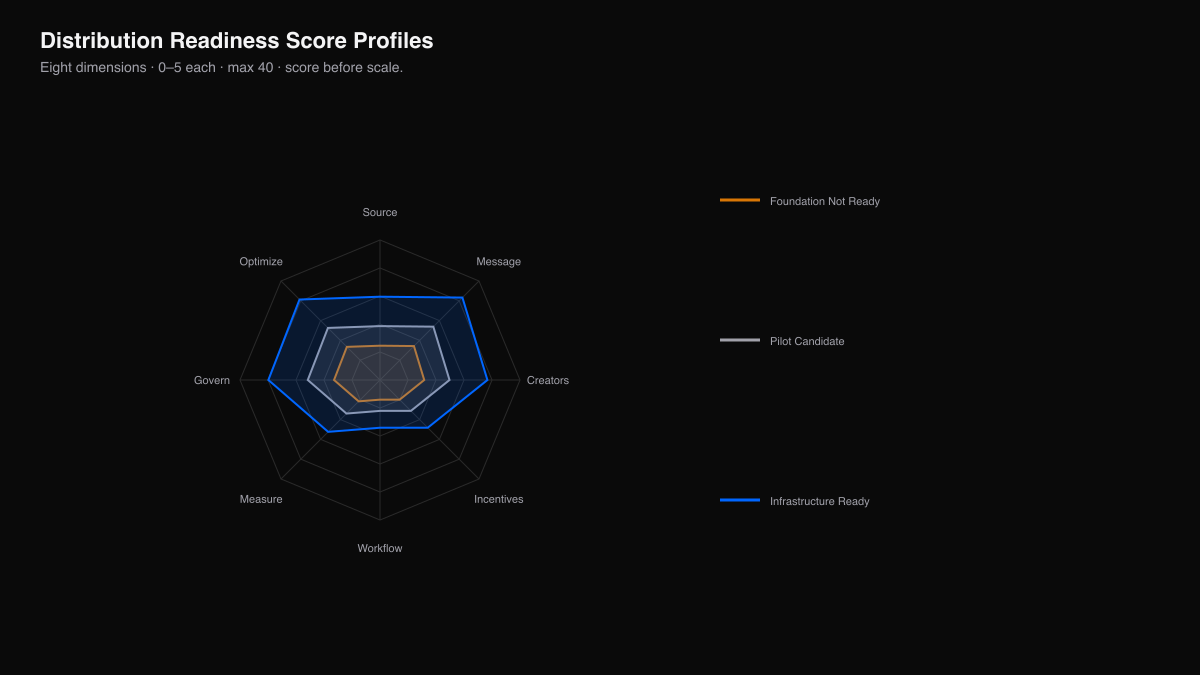
The Distribution Readiness Score produces four bands.
| Score | Band | Meaning | Recommended Action |
|---|---|---|---|
| 0–12 | Foundation Not Ready | The system is missing basic inputs. A creator-powered campaign will likely produce noisy output and weak learning. | Build source inventory, clarify message, define governance, and create a basic workflow before scaling. |
| 13–22 | Pilot Candidate | Enough exists to run a constrained pilot, but the system should limit scope and treat results as early learning. | Run a narrow campaign with clear creator criteria, defined source assets, and manual measurement. |
| 23–31 | Campaign Ready | The team can run structured campaigns and capture useful learning, but infrastructure is not yet fully compounding. | Increase creator volume carefully, improve measurement, create reallocation cadence, and reduce workflow friction. |
| 32–40 | Infrastructure Ready | The operating layer can support repeatable creator-powered distribution and systematic optimization. | Scale creator cohorts, deepen benchmarks, automate workflows, and reallocate capital dynamically. |
Blocker Rules
The total score is not enough. Some weaknesses block scaling even when the average looks acceptable.
Use these blocker rules:
- If Source Content Inventory is 0, do not launch. There is nothing to distribute.
- If Message Clarity and Proof Architecture is 0 or 1, do not scale. The system will amplify confusion.
- If Governance, Rights, and Brand Safety is 0 or 1, do not scale. The system will amplify risk.
- If Workflow and Operating Cadence is 0 or 1, pilot only. The team cannot absorb volume.
- If Measurement Quality is 0 or 1, pilot only. The team cannot learn reliably.
- If the highest dimension is more than three points above the lowest dimension, treat the lowest dimension as the primary bottleneck.
The Distribution Readiness Score is a bottleneck diagnostic, not just a maturity score.
A system scales at the speed of its weakest critical layer.
Read the whole book
The New Attention Economy: The Distribution Manifesto, 11 chapters, free to read and share.
Related courses
Distribution breakdowns
When you are ready to apply it
Ready to launch a campaign?
Use Clipur to turn existing content into distributed short-form reach.