
The Distribution Manifesto
Chapter 2 of 11 · 13 min read
Creator-Powered Distribution
The Category Above the Tactics
The argument
Creator-Powered Distribution is the new infrastructure paradigm for the Attention Crisis.
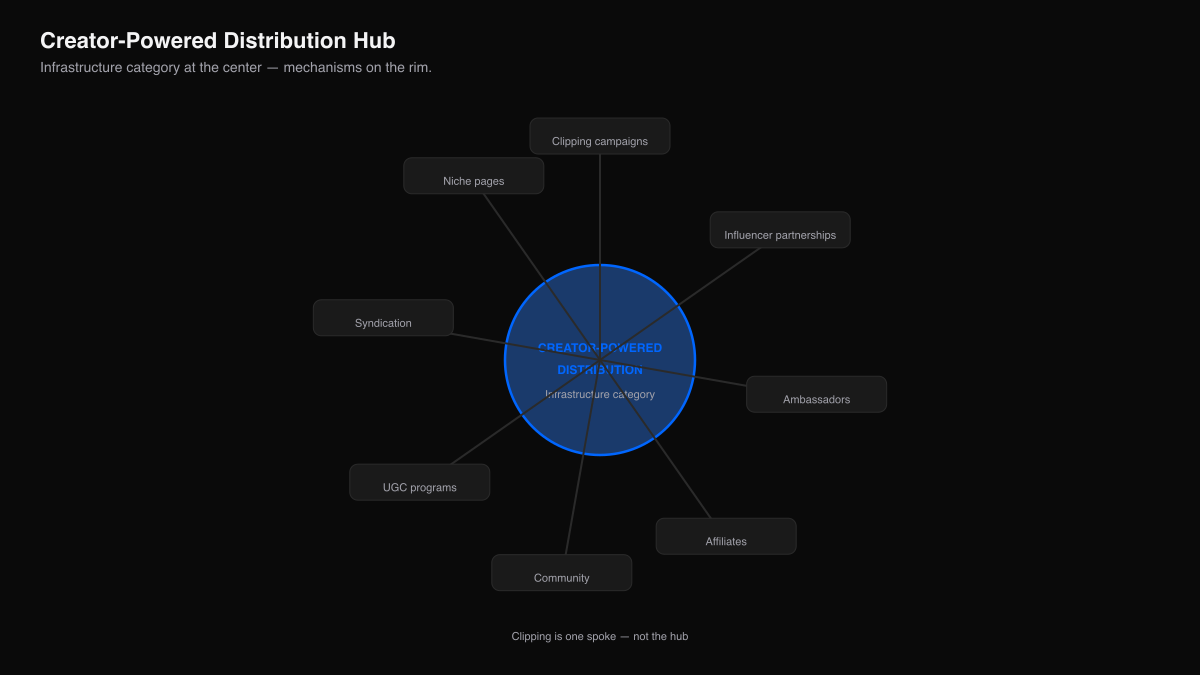
It is not influencer marketing renamed. It is not clipping alone. It is not a synonym for user-generated content, affiliate marketing, ambassador programs, or content repurposing. Those are mechanisms. Creator-Powered Distribution is the operating category above them.
The category describes a coordinated system where creators, clippers, editors, ambassadors, affiliates, niche accounts, and community nodes help package, publish, test, and spread content across platforms under defined incentives, governance, and measurement.
The strategic shift is simple:
Brands no longer build distribution only by buying channels or posting from owned accounts. They build distribution by coordinating networks of people and surfaces around content.
What Comes After the Attention Crisis
Chapter 1 defined the problem: attention is abundant, but reliable access is scarce.
The default responses are predictable. Spend more. Post more. Hire influencers. Make more short-form content. Launch a community. Push employees to share. Build an affiliate program. Start a podcast. Clip the podcast. Buy better creative. Test another platform.
Each response can be useful. None is sufficient by itself.
The missing layer is coordination.
A company does not win the new attention economy by running disconnected tactics. It wins by building an infrastructure layer that coordinates those tactics into a learning system.
That infrastructure layer is where Creator-Powered Distribution lives.
Creator-Powered Distribution starts from three observations:
- Most audiences are now reached through feeds, creators, communities, and recommendation systems, not only through direct brand-controlled channels.
- Source content has more latent distribution value than brands usually capture.
- Independent creators and semi-independent distribution nodes can expand surface area, trust context, packaging variation, and learning rate when coordinated properly.
This is why Creator-Powered Distribution matters. It gives the company a way to make attention less dependent on any single account, channel, creator, or campaign.
Canonical Definition
Creator-Powered Distribution is a distribution model where a brand, founder, media property, or organization uses a coordinated network of creators, clippers, editors, ambassadors, affiliates, niche operators, and community nodes to package, publish, test, and spread content across platforms.
It is not a single tactic. It is an infrastructure category.
It can include:
- Clipping campaigns
- Creator partnerships
- Ambassador programs
- Affiliate distribution
- Community amplification
- Syndication networks
- Niche page distribution
- Employee or founder distribution
- User-generated content systems
- Remix and commentary programs
- AI-assisted content operations
The defining feature is not the presence of creators. The defining feature is coordination.
If a brand pays one creator to post once, that may be influencer marketing. If a brand turns one podcast into clips and posts them from its own account, that may be repurposing. If a brand asks customers to post testimonials, that may be UGC. If a brand builds a governed network of creator nodes that package, publish, test, and distribute content under measurable incentives, that becomes Creator-Powered Distribution.
The Category Boundary
A new category needs clear boundaries. Otherwise it becomes a label applied to everything.
Creator-Powered Distribution includes any mechanism where creators or creator-like nodes materially expand distribution surface area, trust context, creative variation, or learning velocity for a brand or media property.
It does not include every creator activity.
Creator-Powered Distribution Includes
| Mechanism | Included When |
|---|---|
| Clipping campaigns | Clips are distributed through multiple creator or niche surfaces with incentives and tracking |
| Influencer partnerships | Partnerships are part of a broader, repeatable network strategy rather than isolated sponsorships |
| Ambassador programs | Ambassadors are briefed, governed, measured, and activated as distribution nodes |
| Affiliate systems | Affiliates create or route content, not merely links |
| Community amplification | Community nodes distribute content into relevant trust environments |
| UGC programs | User-generated content becomes part of a governed distribution and testing loop |
| Syndication | Content is adapted and routed through multiple context-relevant outlets or accounts |
| AI-assisted content ops | AI helps package, classify, brief, measure, or route content, while humans and creator nodes provide context and distribution |
Creator-Powered Distribution Does Not Include
| Activity | Why It Is Not Enough |
|---|---|
| Posting more from the brand account | More owned output does not create a creator-powered network |
| Cutting long videos into clips only | Repurposing creates assets, not necessarily distribution surfaces |
| Paying one influencer once | One-off activation lacks infrastructure and repeatability |
| Buying paid ads with creator-style creative | The creative may look native, but the distribution is still paid media unless creators are part of the system |
| Running an affiliate link program only | Links without creator packaging or distribution behavior are not sufficient |
| Generating AI content at scale | Synthetic output without trusted distribution and governance adds noise |
This boundary matters because the market will compress language if Clipper University does not define it clearly. Creator-Powered Distribution must be positioned as the layer above the mechanisms.
Why Now
Creator-Powered Distribution is emerging now because several structural shifts are converging.
Shift 1: Platform Feeds Reward Native Packaging
Content does not travel neutrally across platforms. A strong YouTube clip may fail on TikTok. A strong TikTok may fail on LinkedIn. A strong LinkedIn post may fail on Instagram. A strong podcast moment may need different intros, captions, cuts, proof points, and context depending on the surface.
Creator nodes often understand platform-native packaging better than centralized brand teams because they live inside the feeds they publish to.
Shift 2: Audiences Trust Sources Differently
The same message carries different weight depending on who says it and where it appears. A brand claim, founder claim, creator explanation, customer reaction, expert commentary, and peer recommendation are not equivalent impressions.
Creator-Powered Distribution lets the system route messages through different trust contexts instead of forcing every message through the brand account.
Shift 3: Creator Advertising Is Becoming an Always-On Channel
IAB reported that U.S. creator advertising spend was projected to reach $37.1 billion in 2025 and $43.9 billion in 2026. IAB also described a shift from campaign-based influencer marketing toward creator programs embedded more deeply in media strategy and workflow. Source: IAB, 2025 Creator Economy Ad Spend & Strategy Report.
That is a category signal. The market is moving beyond one-off creator sponsorships toward creator operations.
Shift 4: AI Lowers Production Costs and Raises the Noise Floor
AI makes it easier to generate, edit, summarize, caption, repurpose, and format content. That increases output. It also increases noise.
When content production becomes cheaper, distribution, trust, and coordination become more valuable. The scarce resource is not merely the ability to produce media. The scarce resource is the ability to route credible media into relevant attention environments and learn from the result.
Shift 5: Measurement Expectations Are Rising
As media budgets become more performance-oriented, leaders demand clearer links between spend, attention, learning, and business outcomes. The same IAB report identified creator selection, measurement, standards, and tooling as material buyer challenges.
Creator-Powered Distribution must therefore be built with measurement from the start. It cannot be justified only by reach screenshots.
Infrastructure, Not Tactic
The most important conceptual move in this book is separating mechanisms from infrastructure.
A mechanism is a specific way of distributing content: a clip, creator post, affiliate video, ambassador activation, niche page post, community share, paid boost, or syndication placement.
An infrastructure layer is the operating system that coordinates mechanisms.
The Distribution Infrastructure Layer coordinates content, creators, incentives, data, automation, capital allocation, governance, and measurement to produce repeatable distribution outcomes.
It sits above mechanisms and below business strategy.
Business strategy decides what the company is trying to make true. Mechanisms create individual outputs. The infrastructure layer turns those outputs into a system.
Simple Model
Legacy model:
Content -> Channel -> Audience
Infrastructure model:
Strategy -> Content Inventory -> Creator Network -> Platform-Native Packaging -> Distribution Surfaces -> Data Feedback -> Capital Allocation -> More Distribution
The infrastructure layer matters because it changes how results compound.
Without infrastructure, a creator post is an event. With infrastructure, it is a data point. Without infrastructure, a clip is an asset. With infrastructure, it is a distribution test. Without infrastructure, a campaign report is a recap. With infrastructure, it is input for reallocation.
Old Stack vs. New Stack
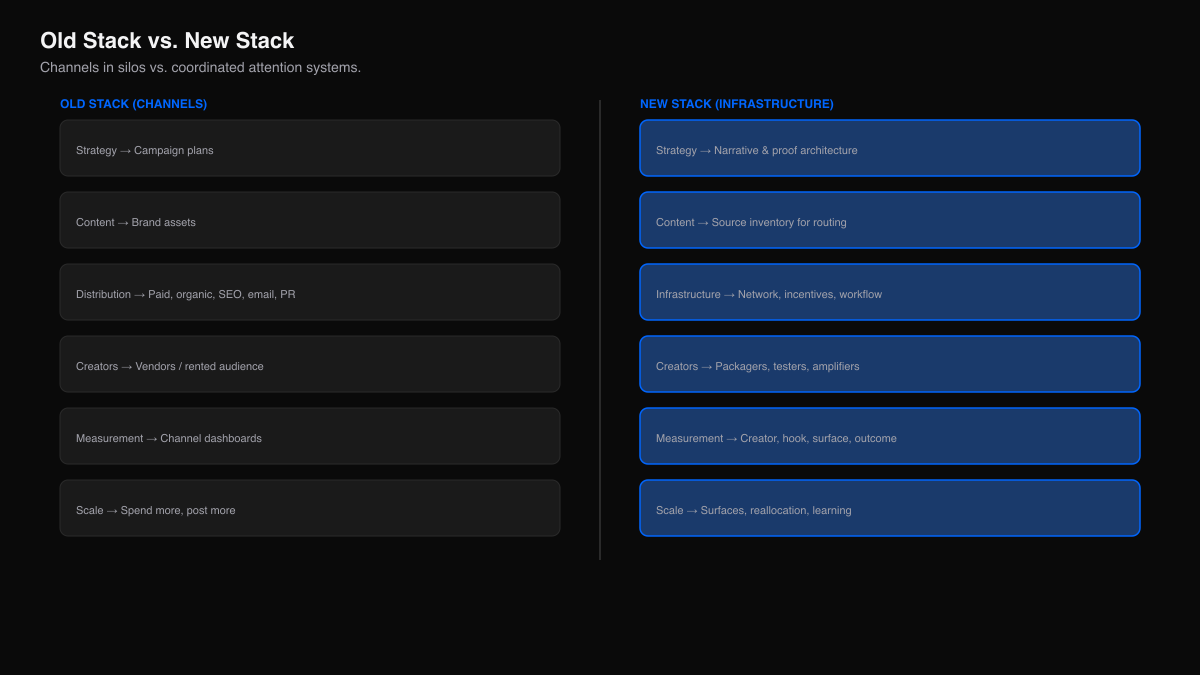
The legacy stack is built around channels. The new stack is built around coordinated attention systems.
Old Stack
| Layer | Legacy Pattern |
|---|---|
| Strategy | Campaign objectives and channel plans |
| Content | Brand-created assets |
| Distribution | Paid ads, organic posts, SEO, email, PR, influencer deals |
| Creator Role | Vendor, spokesperson, or rented audience |
| Measurement | Channel-specific reporting |
| Learning | Often trapped inside teams or agencies |
| Scaling Logic | Spend more, post more, sponsor more |
New Stack
| Layer | Creator-Powered Pattern |
|---|---|
| Strategy | Market narrative, audience priority, offer, and proof architecture |
| Content | Source inventory designed for atomization and routing |
| Distribution Infrastructure | Creator network, incentives, workflow, governance, measurement, reallocation |
| Creator Role | Distribution node, packager, interpreter, tester, amplifier |
| Measurement | Creator, asset, hook, platform, surface, and outcome tracking |
| Learning | Reusable system intelligence |
| Scaling Logic | Increase qualified surfaces, improve creators, reallocate capital, compound learning |
The New Stack does not replace the Old Stack completely. It absorbs it.
Paid media can amplify winning creator assets. SEO can capture demand created by creator surfaces. Email can nurture attention generated elsewhere. Community can deepen trust after discovery. Organic owned channels can host canonical content and proof. Influencer partnerships can become part of a broader creator network.
The shift is architectural. The brand stops asking each tactic to solve distribution alone and starts coordinating tactics through one infrastructure layer.
Core Components of Creator-Powered Distribution
Creator-Powered Distribution has eight core components.
1. Content Inventory
The system needs raw material worth distributing. This can include podcasts, founder videos, livestreams, webinars, customer calls, case studies, internal training, demos, event footage, long-form essays, product updates, research, and community moments.
The question is not merely whether the content exists. The question is whether it contains distributable ideas, proof, stories, demonstrations, tension, or audience-specific angles.
A weak content inventory creates weak distribution. Infrastructure cannot permanently compensate for empty source material.
2. Creator Supply
The system needs creators or creator-like nodes that can package, publish, route, or amplify content. These may be clippers, editors, niche accounts, ambassadors, affiliates, micro-creators, customers, community members, educators, commentators, or operators.
Creator quality matters more than creator count. A large network of low-relevance nodes can create noise, risk, and measurement confusion. A smaller network of high-fit nodes can create better qualified attention.
3. Platform-Native Packaging
Each surface has its own format logic. Hooks, captions, pacing, length, visuals, subtitles, thumbnails, creator voice, and call-to-action structure may need to change by platform and audience.
Platform-native packaging is not cosmetic. It is distribution strategy.
4. Incentive Design
Creators do what the system rewards. If the system rewards only volume, it will get volume. If it rewards raw views, it may get sensationalism or low-quality reach. If it rewards qualified outcomes, compliance, speed, and learning, it can produce better distribution behavior.
Incentives can include flat fees, bounties, view-based payouts, commissions, prizes, access, status, rev-share, equity, education, or future opportunity. The right model depends on the campaign, audience, creator maturity, and risk tolerance.
5. Workflow Infrastructure
A creator-powered system needs operational rails: briefs, source libraries, submissions, reviews, revisions, approvals, publishing rules, rights documentation, payout records, and performance dashboards.
Without workflow infrastructure, the network becomes manual and fragile.
6. Measurement Loop
The system must measure performance by creator, source asset, hook, format, platform, surface, and outcome. It must separate raw reach from qualified attention.
The measurement loop turns distributed content into intelligence.
7. Governance Layer
Creator-powered systems create leverage and risk at the same time. Governance includes rights, disclosures, claims, compliance, brand safety, fraud control, content quality, usage permissions, and escalation rules.
Governance is not bureaucracy. It is what allows the system to scale without destroying trust.
8. Optimization and Capital Allocation
The system must move capital toward what works. Strong creators get more opportunity. Strong hooks become templates. Strong source assets get more distribution. Weak formats are retired. Risky surfaces are constrained. New surfaces are tested.
This is where Creator-Powered Distribution becomes infrastructure rather than activity.
Creator-Powered Distribution vs. Influencer Marketing
The most common misunderstanding is to treat Creator-Powered Distribution as another name for influencer marketing.
The distinction is structural.
Influencer marketing usually starts with a person who already has an audience. The brand asks:
How do we access this creator’s followers?
Creator-Powered Distribution starts with a distribution system. The brand asks:
How do we coordinate many creator nodes and content surfaces so attention compounds?
Comparison
| Dimension | Influencer Marketing | Creator-Powered Distribution |
|---|---|---|
| Primary Unit | Individual creator partnership | Network of creator/distribution nodes |
| Starting Point | Creator audience | Brand content inventory and distribution objective |
| Common Buying Logic | Rent audience and endorsement | Build repeatable surface area and learning |
| Time Horizon | Often campaign-based | Often always-on or repeatable |
| Measurement | Creator post metrics, reach, engagement, sales | Creator, asset, hook, platform, surface, qualified attention, learning, reallocation |
| Creator Role | Spokesperson, endorser, content producer | Packager, distributor, tester, interpreter, amplifier |
| Failure Mode | Expensive one-off posts with limited learning | Network noise if incentives and governance are weak |
Influencer marketing can be one mechanism inside Creator-Powered Distribution. It is not the whole category.
A high-value creator partnership may produce source content, proof, trust, and distribution. But if the partnership is not connected to a broader operating layer, its value is mostly episodic. The infrastructure question is how that creator’s contribution feeds the system: clips, remixes, paid amplification, SEO assets, affiliate loops, community discussions, audience learning, and future creator briefs.
Creator-Powered Distribution vs. Content Repurposing
The second misunderstanding is to equate Creator-Powered Distribution with repurposing.
Repurposing turns content into more assets. Creator-Powered Distribution turns content into more surfaces, signals, and learning loops.
A repurposing workflow may produce:
- 10 clips
- 5 quote cards
- 3 LinkedIn posts
- 1 blog post
- 1 newsletter section
That may be useful. But if those assets only appear on owned channels, the system remains surface-constrained.
Creator-Powered Distribution asks additional questions:
- Which creators should publish or interpret these assets?
- Which surfaces match each angle?
- Which audiences should see which version?
- Which incentives will produce quality output?
- Which metrics distinguish raw reach from qualified attention?
- Which hooks should be repeated?
- Which creators deserve more budget?
- Which source assets should inform future content strategy?
Repurposing is an input. Distribution is the system.
Why Creator-Powered Distribution Complements Paid Media
Paid media remains a major part of the distribution stack. It provides targeting, scale, speed, and controllability. The mistake is not using paid media. The mistake is expecting paid media to solve every distribution problem alone.
Paid media has several structural constraints:
- It can be expensive in competitive auctions.
- It requires constant creative supply.
- It can create reach without trust.
- It may not reveal why a message works across organic or creator contexts.
- It often depends on platform measurement systems.
- It can concentrate learning inside media buying workflows.
Creator-Powered Distribution complements paid media by generating more creative variation, more trust contexts, more organic discovery surfaces, and more early signals about which messages deserve amplification.
In a mature system, creator-powered outputs can become paid inputs. A clip that earns qualified attention through creator distribution may become a candidate for paid amplification. A hook that works across creator surfaces may become ad creative. A creator explanation may become sales enablement. A high-retention clip may become SEO or newsletter material.
Paid media buys reach. Creator-Powered Distribution helps discover what deserves more reach.
Minimum Viable Distribution Infrastructure
A brand does not need a massive creator network to start. It needs enough infrastructure to avoid random activity.
The minimum viable system has eight components:
- Source content inventory: a clear list of assets worth distributing.
- Creator/node roster: a defined supply of creators, clippers, ambassadors, affiliates, or niche accounts.
- Briefing system: clear instructions, examples, claims rules, and target audiences.
- Incentive model: transparent payout, bounty, commission, status, access, or reward structure.
- Submission and approval workflow: a way to review, approve, reject, request revisions, and document rights.
- Publishing rules: account, platform, caption, tagging, disclosure, and timing rules.
- Measurement layer: creator, asset, hook, platform, and outcome tracking.
- Reallocation cadence: weekly or campaign-based decisions about who and what receives more capital.
If there is no measurement loop and no reallocation cadence, the program is not infrastructure. It is activity.
The first version can be simple. A spreadsheet can work. A Notion database can work. Manual review can work. What matters is that the system has the minimum structure required to learn.
Clipur’s long-term role is to make this infrastructure easier to run at scale. Clipper University’s role is to teach the operating model so teams understand what they are building and why it matters.
When to Use Creator-Powered Distribution
Creator-Powered Distribution is especially useful when one or more of the following conditions are true:
- The brand has strong source content but weak distribution surface area.
- Owned channels are not reaching enough relevant people.
- Paid media needs more creative variation or trust context.
- The company has a founder, expert, community, podcast, event, or media asset with untapped clip value.
- The market is education-heavy and benefits from repeated explanations.
- Audience trust depends on peer, creator, or community interpretation.
- The brand needs more experimentation across hooks, platforms, or audience segments.
- The company wants distribution learning that compounds beyond a single campaign.
It is less appropriate when:
- The brand lacks source material and has no clear message.
- Compliance risk cannot be governed.
- The audience is too narrow for creator or community surfaces.
- The team cannot review or measure outputs.
- Leadership only wants guaranteed last-click conversions from every asset.
- Incentives are too weak to attract quality creator participation.
Creator-Powered Distribution is not magic. It is leverage. Leverage requires a stable object to amplify.
Read the whole book
The New Attention Economy: The Distribution Manifesto, 11 chapters, free to read and share.
Related courses
Related Clipipedia terms
Creator-Powered Distribution
Creator-powered distribution is a model where a network of independent creators publishes brand content across their own accounts, multiplying reach far beyond a brand's owned channels.
When you are ready to apply it
Ready to launch a campaign?
Use Clipur to turn existing content into distributed short-form reach.