
The Distribution Manifesto
Chapter 8 of 11 · 17 min read
How to Run a Clipping Campaign
The Mechanism, the Workflow, and the Guardrails
The argument
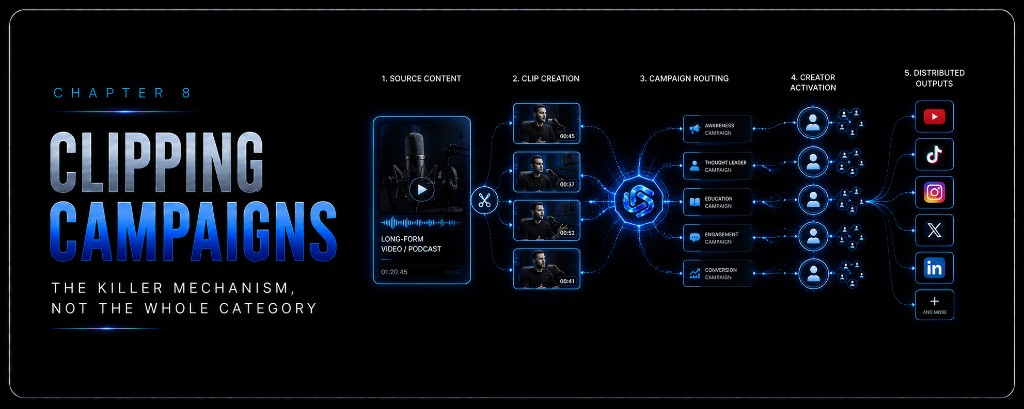
Clipping campaigns are the highest-leverage entry mechanism into Creator-Powered Distribution today because they turn existing source content into many distributed, measurable, platform-native tests.
But clipping is not the whole category.
A clipping campaign is one mechanism inside the broader Distribution Infrastructure Layer. It is powerful because it is concrete, fast to launch, easy to explain, and naturally connected to creator incentives. It can increase content surface area, accelerate hook testing, extend content half-life, produce reusable media assets, and generate creator-level performance data. For many companies, it is the first practical way to experience creator-powered distribution as an operating system rather than as an abstract strategy.
The mistake is stopping there.
A company that treats clipping as the whole category will over-optimize for views, underinvest in governance, ignore creator-network quality, and fail to build the measurement and reallocation systems that make the model compound. A company that treats clipping as a gateway mechanism can use it to build Creator Capital, source-content intelligence, format memory, audience-pocket mapping, and distribution infrastructure.
The operating principle of this chapter is:
Clipping campaigns are not merely a content repurposing tactic. They are a low-friction way to activate the Distribution Flywheel.
The mechanism is simple. The infrastructure is not.
Clipping Campaign
A Clipping Campaign is a structured creator-powered distribution program in which approved creator or clipper nodes identify, package, publish, and measure short-form content units derived from source assets under defined rights, incentives, quality rules, and performance criteria.
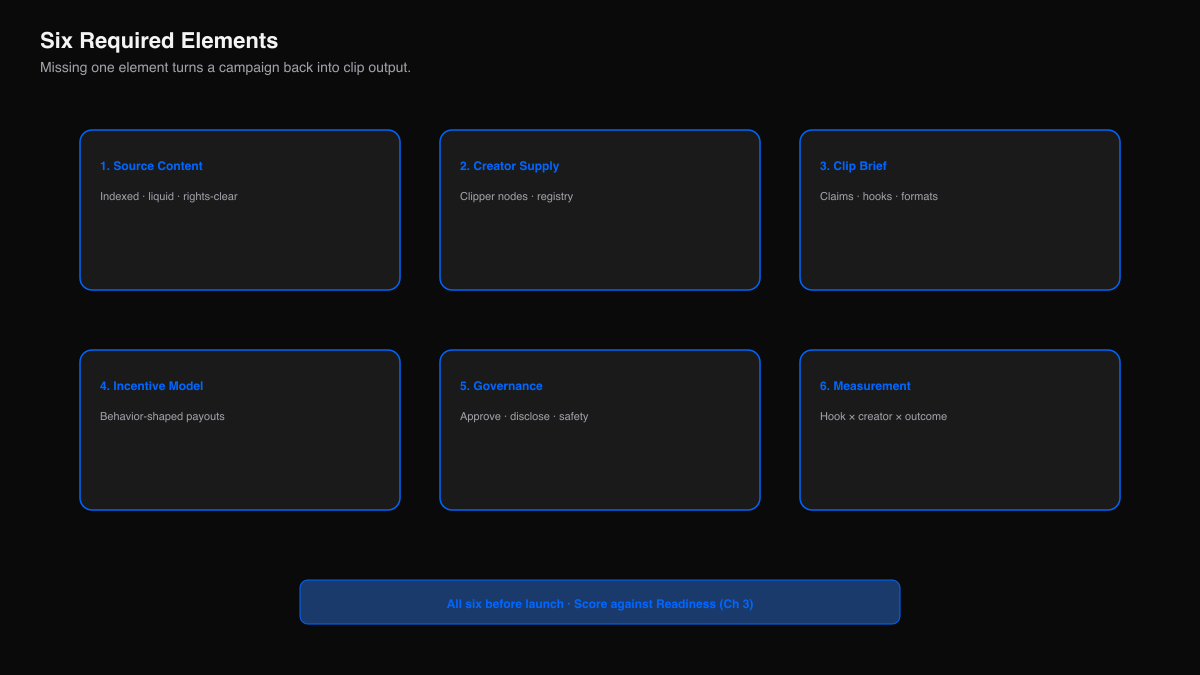
A clipping campaign has six required elements:
- Source content. Long-form or medium-form material that contains extractable moments.
- Clipper or creator supply. People or accounts capable of identifying, editing, contextualizing, or publishing clips.
- Clip brief. The campaign instructions, boundaries, claims, rights, examples, formats, and success criteria.
- Incentive model. The payout structure that determines what creator behavior is rewarded.
- Governance workflow. The approval, rejection, disclosure, rights, claims, and brand-safety system.
- Measurement layer. The reporting structure that tracks output, attention, quality, learning, cost, and downstream business proxies.
If one of those elements is missing, the system may still produce clips, but it is not yet a serious campaign.
A folder of vertical edits is not a clipping campaign.
A freelancer making shorts for a brand account is not necessarily a clipping campaign.
A creator reposting random moments without measurement is not a clipping campaign.
A clipping campaign requires coordinated creator-powered distribution.
The simplest test is this:
Can the system tell which source assets, hooks, creators, platforms, audience pockets, and incentive rules produced qualified distribution value?
If yes, it is behaving like infrastructure.
If no, it is just content output.
Why Clipping Is the Killer Entry Mechanism
Clipping is not the only mechanism inside Creator-Powered Distribution. It is the most practical entry mechanism for many teams because it solves several distribution problems at once.
First, it starts from existing source content. Most companies already have latent media assets: podcasts, webinars, interviews, founder videos, customer calls, livestreams, product walkthroughs, demos, testimonials, course modules, keynote talks, event footage, sales calls, internal training, or long-form YouTube videos. These assets often contain valuable moments, but the original format has limited distribution surface area.
Second, it converts one asset into many tests. A single interview can become clips around pain points, contrarian claims, tactical advice, founder story, product proof, objection handling, customer insight, comparison, commentary, and category education.
Third, it uses platform-native packaging. Short-form clips can be adapted to TikTok, Instagram Reels, YouTube Shorts, LinkedIn, X, Facebook, Snapchat, newsletters, community posts, and paid creative libraries. The clip format is not universal, but the underlying unit can be repackaged.
Fourth, it activates creator supply without requiring full creator-led production. Creators do not always need to invent the idea from zero. They can select, frame, remix, narrate, react, subtitle, edit, contextualize, and distribute source material.
Fifth, it creates learning quickly. A clipping campaign can reveal which hooks, speakers, topics, proof points, formats, creators, and surfaces deserve more investment.
Sixth, it produces reusable assets. Winning clips can become paid ad creative, landing-page proof, sales-enablement material, email embeds, social proof, training examples, SEO article inputs, course modules, or future creator briefs.
The market context reinforces the case. Creator advertising is no longer a fringe line item: IAB reported that U.S. creator ad spend was projected to reach $37 billion in 2025, up 26% year over year, and expected to reach $44 billion in 2026. IAB also noted that creator-campaign buyers still struggle with choosing the right creators, measuring outcomes, and building standards and tools. Those are infrastructure problems, not just content problems.
Digital video is also absorbing more media spend. IAB’s 2025 digital video report said U.S. digital video ad spend grew 18% year over year in 2024 to $64 billion and was projected to reach $72 billion in 2025. IAB’s 2026 update projected digital video above $80 billion and specifically noted social video’s growth relative to CTV. Clipping campaigns sit inside that broader shift toward video-native attention.
But the market shift does not automatically make every clipping campaign effective.
The mechanism works when the company has enough source quality, creator supply, governance, and measurement to turn clips into qualified distribution. It fails when teams treat clipping as cheap content labor.
The Objects of a Clipping Campaign
A clipping campaign has several core objects. Operators need precise language for each one.
Source Asset
A Source Asset is the original media asset from which clips are derived.
Examples include:
- Podcast episodes.
- Interviews.
- Founder talks.
- Webinars.
- Product demos.
- Livestreams.
- Customer calls with usage rights.
- Conference footage.
- Long-form YouTube videos.
- Course lessons.
- Case-study recordings.
- Testimonial videos.
- Internal explainers approved for external use.
A strong source asset has high Content Liquidity. It contains extractable hooks, proof points, modular ideas, emotional moments, visual clarity, context durability, and enough rights clarity to be reused.
Clip Unit
A Clip Unit is a short-form content asset extracted, edited, framed, remixed, narrated, reacted to, or otherwise packaged from a source asset for distribution on a specific platform or surface.
The clip unit is not merely a cut. It includes:
- The selected moment.
- The opening hook.
- The frame or title.
- Captions or subtitles.
- Visual pacing.
- Context setting.
- Platform-specific packaging.
- CTA or next-step logic.
- Metadata or tracking tags.
- Rights and claim status.
A clip unit should be measured as an independent distribution asset.
Clip Portfolio
A Clip Portfolio is the set of clips produced from a source asset, campaign, topic, creator cohort, or distribution cycle.
The portfolio matters because one clip rarely explains the whole system. The operator should evaluate distribution at the portfolio level:
- Which source assets produced the best clips?
- Which hooks repeated across winners?
- Which topics failed despite strong editing?
- Which creator node types produced qualified attention?
- Which formats transferred across platforms?
- Which clips should be recycled, boosted, or converted into ads?
- Which assets generated learning even when they did not generate high reach?
A mature clipping campaign does not ask only, “Which clip won?”
It asks, “What did the portfolio reveal?”
Clip Brief
A Clip Brief is the campaign document that tells creators what source assets are available, what objectives matter, what boundaries cannot be crossed, what examples look like, how clips should be submitted or published, how performance will be measured, and how payouts will work.
A weak brief produces creator confusion.
A rigid brief kills platform-native performance.
A strong brief creates structured freedom.
Qualified View
A Qualified View is a view that meets the campaign’s minimum standards for relevance, validity, context, platform compliance, and measurement eligibility.
A raw view is a platform-reported count. It may be useful, but it is not always strategically meaningful.
A qualified view may require filters such as:
- Platform is approved.
- Creator account is approved.
- Geography matches the campaign.
- Audience context is relevant.
- View is not fraudulent or obviously invalid.
- Clip followed claims and disclosure rules.
- Clip remained live for the required window.
- Clip did not use banned tactics.
- View falls inside the campaign reporting period.
- The clip did not misrepresent the source content or offer.
Qualified View definitions will vary by campaign. The point is not to create one universal standard prematurely. The point is to stop pretending every raw view is equally valuable.
The Clipping Campaign Architecture
A clipping campaign is easiest to manage when it is treated as an operating architecture rather than as a content request.
The architecture has ten layers.
1. Source Intake Layer
The campaign starts with source assets.
The operator should collect:
- Asset title.
- Asset URL or file.
- Owner.
- Speaker names.
- Topic tags.
- Audience tags.
- Rights status.
- Usage restrictions.
- Claim restrictions.
- Transcript.
- Timestamp notes.
- Existing performance data.
- Recommended clip angles.
Source intake is often skipped because it feels administrative. That is a mistake. Bad source intake creates downstream confusion, slow review, rights issues, weak clips, and poor learning.
2. Source Selection Layer
Not every asset should be clipped.
A source asset should be selected when it has enough liquidity to support distribution.
Selection criteria include:
- Hook density.
- Proof density.
- Speaker clarity.
- Audio and visual quality.
- Topic relevance.
- Audience relevance.
- Context durability.
- Claim safety.
- Rights clarity.
- Format adaptability.
- Strategic timing.
A campaign with weak source selection can recruit strong creators and still fail.
3. Campaign Brief Layer
The brief defines the operating rules.
It should include:
- Campaign objective.
- Target audience.
- Approved source assets.
- Priority topics.
- Required context.
- Claim boundaries.
- Banned claims.
- Disclosure rules.
- Brand-safety rules.
- Platform rules.
- Creative freedom zones.
- Examples of good clips.
- Examples of rejected clips.
- Submission workflow.
- Publishing workflow.
- Measurement rules.
- Payout rules.
- Timeline.
- Escalation path.
The brief is not a formality. It is the control plane.
4. Creator Activation Layer
The campaign needs creator or clipper nodes.
Activation includes:
- Recruiting creators.
- Screening for fit.
- Matching creators to source assets.
- Giving access to the brief and media library.
- Explaining payout rules.
- Confirming rights and disclosure requirements.
- Setting deadlines.
- Capturing account handles and platform surfaces.
- Confirming submission and reporting rules.
The operator should know whether the campaign needs clipper nodes, narrator nodes, reaction nodes, niche expert nodes, proof nodes, community nodes, or amplifier nodes.
A clipping campaign does not always require the creator to appear on camera. But it does require a creator node capable of producing a distribution event.
5. Packaging Layer
Packaging turns source moments into platform-native assets.
Packaging decisions include:
- Hook selection.
- Clip length.
- Caption style.
- Visual framing.
- On-screen text.
- Cut pace.
- Context setup.
- Native trend usage.
- Speaker emphasis.
- Reaction layer.
- Voiceover layer.
- CTA or no CTA.
- Thumbnail or cover.
- Platform-specific variations.
Packaging is where many campaigns win or lose.
A strong source moment with weak packaging may fail. A modest source moment with strong packaging may produce useful attention. The operator should not treat the edit as mechanical.
6. Submission and Publishing Layer
Some campaigns require clips to be submitted for approval before publication. Others allow trusted creators to publish directly inside preapproved rules and report URLs afterward. Mature systems may use different workflows by creator tier.
A simple model:
| Creator Tier | Review Model | Best Use |
|---|---|---|
| New creator | Pre-publication review | Reduces early risk |
| Qualified creator | Fast review or sampled review | Balances speed and quality |
| Trusted creator | Publish inside boundaries, post-publication audit | Maximizes velocity |
| High-risk category creator | Pre-publication review regardless of tier | Protects claims and compliance |
The review model should match risk.
Low-risk awareness clips can move faster.
Regulated claims, financial promises, health claims, earnings claims, testimonials, or competitive claims require stricter governance.
7. Approval Layer
Approval is not just a yes/no decision. It should produce structured learning.
Every rejected clip should have a reason code.
Example rejection codes:
- Misleading hook.
- Missing context.
- Claim violation.
- Rights issue.
- Disclosure missing.
- Off-brand framing.
- Poor audio or visual quality.
- Weak platform packaging.
- Duplicate angle.
- Low source fidelity.
- Incorrect CTA.
- Banned tactic.
- Not aligned with campaign objective.
Reason codes convert review from subjective feedback into campaign intelligence.
The 1,700-clip queue
Review capacity sounds like an administrative detail until it becomes the campaign.
In June 2026, we had approximately 1,700 clips waiting for review. Clearing the queue and keeping up with new submissions would have required an estimated three to five full-time review operators. We had successfully scaled intake and accidentally moved the entire bottleneck into approval.
The tempting response was a simple automation rule: reject any submission below a fixed engagement threshold. It looked efficient until we examined the exceptions. A good clip from a new account could fail the threshold. A bad clip with manipulated engagement could pass it. A platform-specific signal could look weak in the first hours and become meaningful later.
The clean rule was not the accurate rule.
The lesson was not that automation is useless. The lesson was that automation should route judgment, not pretend judgment no longer exists. Use it to flag duplication, missing fields, obvious rights violations, known fraud patterns, and low-confidence submissions. Keep human review where context, claims, brand fit, and edge cases determine the answer.
Submission volume is not throughput. Approved, measured, on-brief distribution is throughput.
8. Measurement Layer
Measurement should capture creator, asset, source, hook, platform, audience, and cost data.
Minimum fields include:
- Creator ID.
- Creator tier.
- Creator node type.
- Source asset ID.
- Clip ID.
- Hook category.
- Topic category.
- Platform.
- Publish date.
- URL.
- Approved/rejected status.
- Rejection reason.
- Raw views.
- Qualified views.
- Watch-time proxy.
- Engagement quality.
- Shares/saves.
- Comments of interest.
- Clicks or conversion proxy if available.
- Payout amount.
- Rights status.
- Reuse eligibility.
This is where many clipping campaigns remain immature. They collect views and miss the rest.
Counting attention is only the start. The campaign must build performance memory.
9. Reallocation Layer
The campaign should move budget, source access, bonus pools, creator priority, and review speed toward what is working.
Reallocation can happen across:
- Creators.
- Creator node types.
- Source assets.
- Hooks.
- Topics.
- Platforms.
- Clip lengths.
- Caption styles.
- CTAs.
- Payout rules.
- Review models.
A clipping campaign without reallocation is a batch production job.
A clipping campaign with reallocation is a flywheel cycle.
10. Retrospective Layer
At the end of the campaign, the operator should produce a structured retrospective.
It should answer:
- Which source assets were most productive?
- Which clips generated qualified attention?
- Which creators should be retained, upgraded, paused, or removed?
- Which hooks should be repeated?
- Which claims caused review friction?
- Which platforms produced useful attention?
- Which assets are reusable?
- Which parts of the workflow slowed velocity?
- Which payout rules created the desired behavior?
- What should change in the next campaign?
The retrospective is where clipping becomes infrastructure.
Operational proof: volume only matters when it can be filtered
One anonymized campaign for a regulated financial platform shows why submission volume and approved output must be reported separately.
The campaign used two livestreams as source material and activated 135 creator accounts. At the reporting snapshot:
- 536 clips had been submitted.
- 185 clips had been approved.
- 119 clips had been filtered for quality or brief compliance.
- 232 clips were still pending review.
- Approved clips accounted for 507,400 in tracked reach.
- Pending clips represented approximately 156,000 additional views awaiting review.
- The top approved clip had 10,700 views.
If I wanted the biggest marketing number, I could say “650,000+ tracked views” and stop. That would hide the operation.
The more useful result is the funnel. Only 34.5% of submissions had been approved at the reporting snapshot. Roughly 22.2% had already been filtered. More than 43% remained pending. Those numbers expose creator quality, brief clarity, review capacity, and the cost of governance.
The campaign did not report deposits, trading volume, revenue, or conversion. None of those outcomes should be inferred from the view total. The proof is operational: a real managed clipping campaign can activate more than a hundred accounts, accept hundreds of submissions, reject off-brief work, separate pending reach from approved reach, and preserve a review trail.
That distinction is what makes the case useful. A content farm reports the largest visible number. A distribution operator reports the state of the pipeline.
Evidence note: Anonymized Clipur internal campaign report, reporting snapshot from 2026. Client identity withheld. Approved and pending reach were tracked separately; conversion and revenue were outside the reported scope.
The Clip Brief as Control Plane
The clip brief is the most underrated object in a clipping campaign.
It is not only an instruction document. It is the control plane for creator behavior.
A strong brief contains three kinds of information.
Strategic Context
Creators need to understand the campaign job.
Include:
- Campaign objective.
- Target audience.
- Audience pain points.
- Desired perception shift.
- Priority source assets.
- Priority topics.
- Competitive context if relevant.
- Examples of strong framing.
- Examples of weak framing.
Without strategic context, creators guess.
Operating Rules
Creators need to know what they can and cannot do.
Include:
- Approved assets.
- Asset usage permissions.
- Required disclosures.
- Banned claims.
- Claims that require exact language.
- Visual restrictions.
- Music restrictions.
- Platform restrictions.
- CTA rules.
- Posting windows.
- Submission rules.
- Revision rules.
- Payout eligibility rules.
Without operating rules, governance becomes reactive.
Creative Freedom Zones
Creators need to know where they are allowed to adapt.
Include:
- Hook freedom.
- Caption freedom.
- Edit style freedom.
- Voiceover freedom.
- Reaction freedom.
- Format examples.
- Allowed remix patterns.
- Allowed commentary.
- Allowed humor or meme use.
Without creative freedom, the campaign becomes a distributed brand account.
The best brief is neither vague nor controlling.
It defines the non-negotiables clearly and leaves room for creator-native execution.
Red, Yellow, and Green Claim Zones
Clipping campaigns need a simple claims governance system.
The red/yellow/green model is useful.
Green Zone
Green-zone claims are safe for creators to use freely inside the brief.
Examples:
- Approved product descriptions.
- General brand positioning.
- Publicly available facts.
- Non-regulated educational statements.
- Approved source quotes with context preserved.
- High-level category commentary.
Creators can adapt green-zone claims with creative freedom.
Yellow Zone
Yellow-zone claims require specific language, context, or approval.
Examples:
- Performance claims.
- Customer results.
- Comparative claims.
- Pricing or savings claims.
- Market share claims.
- Technical claims.
- Outcome claims that depend on conditions.
- Testimonials that require context.
Creators can use yellow-zone claims only within defined boundaries.
Red Zone
Red-zone claims are banned.
Examples:
- Guaranteed outcomes.
- Unsupported earnings claims.
- False scarcity.
- Misleading before/after claims.
- Unverified customer results.
- Medical, financial, legal, or compliance-sensitive claims without approval.
- Claims that misrepresent the source asset.
- Competitor statements not cleared by the brand.
Red-zone claims should trigger rejection or escalation.
The purpose of this model is not to slow creators down. It is to let them move faster by making the boundaries explicit.
This is especially important because endorsement and testimonial rules can apply when creators communicate promotional messages. The FTC’s business guidance on endorsements, influencers, and reviews emphasizes clear disclosure of material connections, while 16 CFR Part 255 contains the formal U.S. guides concerning endorsements and testimonials. Paid clipping campaigns therefore need disclosure rules, monitoring, and advertiser-side responsibility built into the operating system. This book provides operational education, not legal advice; regulated or high-risk campaigns should be reviewed by qualified counsel.
Clipping Economics
The economics of clipping should be measured more carefully than most teams measure them.
A raw payout-to-views calculation is not enough.
The full cost of a clipping campaign includes:
- Creator payouts.
- Winner bonuses.
- Platform or software fees.
- Source-content preparation.
- Transcript and asset management.
- Brief writing.
- Creator recruitment.
- Creator support.
- Review and approval time.
- Legal or compliance review.
- Measurement and reporting.
- Payout reconciliation.
- Fraud detection.
- Retrospective and reallocation work.
The full output includes:
- Qualified views.
- Approved clips.
- Published clips.
- Reusable assets.
- Winning hooks.
- Creator performance signals.
- Source performance signals.
- Audience objections.
- Platform learning.
- Paid creative candidates.
- Sales-assist assets.
- Search demand proxies.
- Leads or conversions where measurable.
The basic economics model:
Total Campaign Cost = Creator Payouts + Bonus Pools + Platform Fees + Source Prep Cost + Review Cost + Measurement Cost + Risk Cost
Creator-Powered CPM = (Total Campaign Cost / Qualified Views) x 1,000
Cost Per Approved Clip = Total Campaign Cost / Approved Clips
Cost Per Reusable Asset = Total Campaign Cost / Reusable Assets
Learning Yield = Validated Learnings / Total Campaign Cost
Clip Portfolio Efficiency = Qualified Views + Reusable Assets + Validated Learnings + Business Proxies / Total Campaign Cost
The operator should not force every clipping campaign into one metric. Different campaign jobs need different economic views.
An awareness campaign may prioritize qualified views and creator-powered CPM.
A creative-testing campaign may prioritize learning yield and winning-hook discovery.
A sales-enablement campaign may prioritize reusable proof assets.
A conversion campaign may prioritize qualified clicks, signups, trials, purchases, or pipeline influence.
The common mistake is comparing clipping against paid ads using only CPM.
That can be useful, but it is incomplete. Paid ads buy controlled placement. Clipping campaigns can produce attention, learning, creator-network memory, and reusable assets. They can also create review cost, governance risk, and measurement noise. A fair comparison must include both sides.
Fraud, Gaming, and Low-Quality Attention
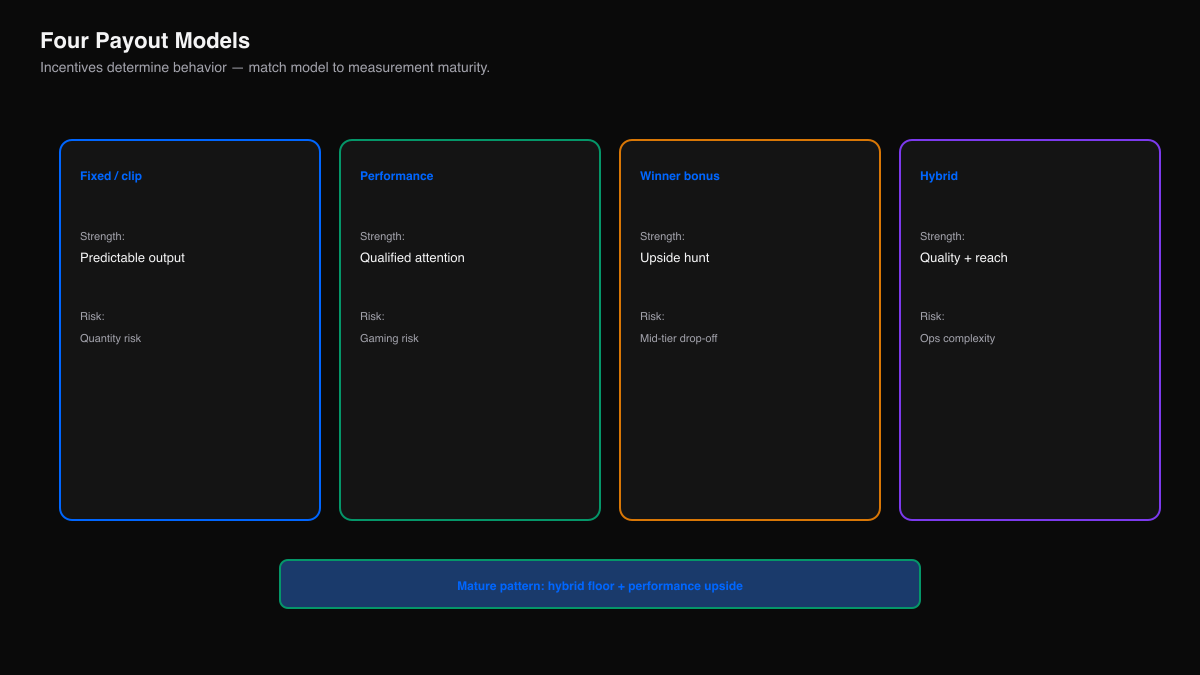
Paid clipping campaigns create incentive surfaces. Incentive surfaces create gaming risk.
Common risks include:
- Inflated views.
- Bot traffic.
- Engagement pods.
- Misleading hooks.
- Stolen clips.
- Duplicate submissions.
- Reposting without permission.
- Hidden paid promotion.
- Missing disclosures.
- Off-platform traffic manipulation.
- False attribution.
- Low-context audience bait.
- Creator self-dealing.
- Using unapproved accounts.
- Publishing and deleting before audit.
A creator-powered campaign must be designed with integrity controls.
Useful controls include:
- Approved creator accounts.
- Approved platform surfaces.
- URL submission requirements.
- Minimum live-window requirements.
- Screenshot or analytics backup.
- Anomaly detection.
- View-quality review.
- Rejection reason codes.
- Duplicate detection.
- Claim-safety review.
- Disclosure checks.
- Payout hold periods.
- Creator strike system.
- Trusted creator tiers.
- Audit sampling.
Integrity rules should protect the economics and credibility of the campaign without turning quality control into punishment.
If the campaign cannot distinguish qualified attention from low-quality attention, it cannot pay intelligently.
If it cannot pay intelligently, it cannot retain the right creators.
If it cannot retain the right creators, it cannot build Creator Capital.
The Minimum Viable Clipping Campaign
A company does not need a fully mature infrastructure layer to run a useful first clipping campaign. But it does need a minimum viable system.
The Minimum Viable Clipping Campaign includes:
- Three to ten source assets with clear rights.
- A source-content inventory with tags and notes.
- A campaign brief with audience, goal, claims, rights, examples, and payout rules.
- A small pool of approved creator or clipper nodes.
- A basic submission workflow.
- A review workflow with rejection reasons.
- A payout model that rewards quality and/or qualified attention.
- Clip-level tracking.
- A weekly reallocation review.
- A post-campaign retrospective.
The first campaign should prioritize learning over scale.
The question is not:
How many clips can we force into market?
The better question is:
What do we need to learn to make the second campaign better than the first?
A minimum viable campaign should produce enough signal to improve source selection, brief quality, creator quality, payout design, review rules, and measurement.
If it does, it has done its job.
Read the whole book
The New Attention Economy: The Distribution Manifesto, 11 chapters, free to read and share.
Related courses
Distribution breakdowns
Related Clipipedia terms
Clipping Campaign
A clipping campaign is a coordinated effort that turns existing long-form content into short, platform-native clips and distributes them at scale across social media to maximize reach and impressions.
Campaign Brief
A campaign brief is the document that tells clippers what to make and how to make it.
CPM (Cost Per Mille)
CPM is the cost of one thousand impressions, a standard way to compare distribution efficiency.
Campaign Readiness
Campaign readiness is the degree to which source content, creator supply, governance, and measurement are ready before a clipping campaign launches.
Qualified View
A qualified view is a view that meets campaign-defined standards for relevance, validity, and measurement eligibility.
Quality Scoring
Quality scoring is a structured rubric for evaluating clip or campaign output before scale decisions.
When you are ready to apply it
Ready to launch a campaign?
Use Clipur to turn existing content into distributed short-form reach.